Showing posts with label block tatting. Show all posts

Saturday, 25 April 2026

3D solid tatting

Pin It now!

 Who knew these cute little birds would be the cause to anger some people who then went on to make them an extinct species in their ecosystem! This pertains to only one specific FB group from which many of us have been booted out while others have left voluntarily. We now have a new group started by Vicki Clarke, called 3-D Tatting. All birds wiped out from that one group are now flocking together in this group, LOL, and others as well.

Bluebird in solid tatting
Continuing from my last post about flat solid tatting, see how wonderfully it can be applied to tatted amigurumi models!!! All pics in this post belong to Carolyn Craig who is the experimenter, designer, and tatter. I will quote some of what she shared with me privately with permission to use whatever was needed.

What is Amigurumi - Amigurumi is the Japanese art of crocheting or knitting small, stuffed yarn creatures or objects. The word combines "ami" (meaning knitted or crocheted) and "nuigurumi" (meaning stuffed doll). Amigurumi are typically worked in spiral rounds using basic crochet stitches like single crochet and invisible decrease. They can now add tatting to the list for amigurumi. CRAIG

Solid Tatting by CAROLYN CRAIG - is the same as amigurumi. It is continuous rounds instead of joined rounds in a spiral, but it can also do flat solid tatting which is continuous. 
3-D Lips
After her 2D solid tatting in 2020, Carolyn tried these lips, working them in continuous rounds and stuffing them before sewing them closed
The Lips became the body of the birds. I am a retired art teacher. I have used basic shapes in clay, paper, and other materials to make different objects for class projects. I see how some can be made with the solid tatting, I just have not mastered all the ways it can be used. CRAIG
3-D Mouse Family
"The mouse family in solid tatting with jute... continuous spirally circle of tatting"

3-D Robin
This Robin is worked in yarn. 
You can see how she is experimenting with different threads/yarns as well as sizes to get the desired result.
The collage shows how the body is being worked as a single entity, a continuous round which includes the head in a different colour. Before the body is closed completely, it is stuffed. The tail, wings, beak, eyes are added later.

Below we see the assembly parts of a solid tatted Sparrow. 

3-D Sparrow
"This sparrow was done in 4 ply acrylic yarn with a Moonlit shuttle. The sparrow is continuous solid tatting in a spiral to form body and head. The spine and tail are solid flat tatting in one piece. The wings are regular tatting."

The second image is the parts of sparrow solid tatting in a continuous spiral - body and head, Flat solid tatting which is continuous - spine and tail, and regular tatting - wings with moonlit shuttle in background. 

If you look close at the flat spine and tail, one of the two stitches used to create SOLID TATTING can be seen in the top and bottom row……. CRAIG

TIP: Carolyn uses two types of lock join to achieve her compact 3D solid tatting. For the most part the lock join made through the wasitband of a double stitch which she calls LFW (LJ through front waistband). It is the horizontal bar of a DS when the DS is facing us; the LJ is made within the stitch, between two half-stitches. The 2nd is when the LJ is made through the back waistband - LBW. This is simply like joining between two DS. Since 3D model is tatted all from the front, the LFW is used much more. LBW is used for increases/decreases to shape the model. 

3-D Bluebird
"The blue bird is with size 3 tatting thread (but tail and wings are still in size 3 thread instead of size 10)"
 
A closer look at these beauties!

These are but 3 solid birds designs. Her aviary consists of 7 or 8 different birds and you can see them in her FB timeline or the 3-D Tatting group (besides a few other groups). There are many active preservationists who stepped in to prevent extinction! Carolyn will be sharing her process and experiments in detail in future.
🐦🐦🐦🐦🐦

3D in Tatting - There are numerous ways to tat 3D models with or without stuffing. Some are worked continuously (as in the listing below) while others can include joining motifs, bowl shapes, covering a balloon or ornament, etc.  These could include in no particular order ....

Please note that the above list is by no means exhaustive! Feel free to remind me of any I might've missed.
🐦🐦🐦🐦🐦

I wasn't going to, but this is adorably cheeky to not share! Here's what some veteran masters of tatting are doing in the above FB group .... Anita posted this yesterday and then left the group and told me I could share after several other tatters expressed their desire to copy/paste. 
Please note that this is the vintage edging (recreated by Anita) that inspired my threader holder motif here - https://tipsaroundthehome.blogspot.com/2026/04/literally-out-of-box.html

And now I am told Martha Ess has also posted something similar listing all our greats who inspired her 3D design using block tatting and it reads like a true historical timeline. 

Cheeky but civilised and disciplined and following all rules! 
🐦🐦🐦🐦🐦

Many thanks to Carolyn for allowing me to share her lovely work and details and to ALL others mentioned who allow us to use their ideas and techniques so that we do not have to reinvent the wheel.

Thursday, 23 April 2026

2D solid tatting

Pin It now!

 Carolyn Craig's journey of 3D solid tatting started with a flat 2D fabric which she first made and shared publicly in 2020.

This was the piece. In her words -
"My first piece of solid tatting was for a tapestry purse in 2020. I tatted a flat piece of solid tatting for tube at the bottom of the purse for a scarf or umbrella."

This is what the 2D solid tatting fabric looks like without the appliqued tatted letters. It is worked continuously in to and fro rows with a shuttle and ball. Thus we work from the front from left to right, turn work and go back from right to left in continuous succession and repetition.
💟
Above is my first attempt when she privately discussed her process with me. I chose to start with a ring and worked in continuous chains around it.  It is worked all from the front and the joins are made through the waistband of each double stitch (she calls this LFW - lock join front waistband) of the previous round.

My mistake was to use knitting cotton size 10. This is not as firm as crochet cotton. Also I couldn't always make out the joining point and probably fudged.
Nevertheless it gave me enough of an idea of how Carolyn worked her solid tatting.
One can continue this piece and end up with a 3D model but more on that in the next post.
💟
Meanwhile Carolyn has created a PDF with her pictorial on flat or 2D solid tatting. She graciouslygave me permission to share her work here. I like the applications she included towards the end. 
2-D Solid Tatting with Carolyn Craig April, 2026 PDF - 
The tutorial starts with a foundation chain rather than a ring and I followed along ....
 
Her tip about using a marker or pin is Really helpful. 
This time I used Anchor crochet cotton size 20 in single colour and worked off a ball with single shuttle.There were some errors and I had to re-tat the 3rd row ... practice will make it neater.

This is how it looks from the back - like knitting!!! Seed stitch as some members said.

TIP: In a square or rectangular piece where we alternate between working rows from the front and the back, all joins are made through the 'hidden picot' since we are not deliberately making any picot.  Carolyn terms this the LBW (Lock join to back waistband), 
💟
Carolyn pointed out that while some pinholes are fine in a flat piece, if we wish to use it for 3D, the space should be as minimal as possible to avoid any stuffing from being visible. So I continued with tighter stitches ....

You can see the difference between the upper and lower halves. 
Texturally, too, the upper half is stiff. Although I do like the lower one - it feels more cloth-like when handled. Each has its use.
The same sampler from the back. The seed stitch pattern is more obvious in the lower half than the upper one, though it could be my own fault.

At present this is set aside. Oh by the way, I used 7 double stitches per row and am certain there was some fudging at some of the turns.  
💟
So far, when worked in ROWS of 1DS chains, it is nothing different than Dora Young's patterns. The difference is merely in design; in the combination of dense and open areas. And she deliberately made 'picots' at each lock join. 


Since I last posted, this is how far my Dora Young's Round Pinwheel Doily from her 'All New Knotless Tatting Designs' (2nd ed) has reached.  As of 5th Oct 2025, it is 14 cms or 5.5 inches in diameter. The dense pinwheel is complete and only the open chain rounds are left. However, I ran out of thread and couldn't decide on how to proceed. 
💟
To recap, 
Solid Tatting is simply dense area(s) in any tatted lace. Usually the dense is interspersed with lighter/airier portions in interesting designs. Solid tatting also includes tatted formations such as blocks, coils, tallies, onion rings, etc. Remember how many of Eleonore Endrucks'  patterns have broad and diversely shaped blocks interspersed with more open areas? Die Schiffchen-Spitzen, 1920 -https://docs.google.com/document/d/17LEVftXweztBIOWh4sL4BB7bX65ssoOsOn4oXIgCepY/view. The difference is that she uses longer chain segments as well as segmented blocks rather than single DS chains. Even before Endrucks. we come across a couple of projects in Lady Hoare's book (1910) where continuous rounds of tiered chains provide a dense highlight to patterns.
UPDATE: Double Chains also offer a solid design option, however they require a minimum of Three threads - https://tipsaroundthehome.blogspot.com/2024/09/pleasure-and-pondering.html

However solid tatting can also be applied to 3D models as we shall see in the next post. 

Many many thanks to Carolyn .... the best is yet to come! 

Wednesday, 1 April 2026

too clever by half

Pin It now!

or too lazy ... take your pick, LOL. So I actually completed a motif from scratch today as celebration of the International Tatting Day! Wanted to tat enough to upload to our Endrucks 1920 Project FB group and then continue tomorrow along with a blogpost. Wonder of wonders, my smart take meant I 'finished' the motif et al much before the end of the day! 

I had decided to tat a butterfly when I realised it would mean a line/row bingo as mentioned in my post here. And my first search was in the EP directory of butterfly derivatives. This was one motif I hadn't tatted, so mind made up. That it would happen so soon, well .... and that it had block tatting was something I hadn't planned on either.

This is the E16 Grazia Butterfly derived and designed by Pina Pinto for the #Endrucks1920Project; pictorial and written pattern by Ninetta Caruso. with a bit of input from me. Here is the direct link to the PDF - https://drive.google.com/file/d/10mqdUjIcdRADIuGt5il0C2PUvGn0HthK/view

And as you can see if you compare the models in the PDF to mine, this is in profile! After tatting two wings it looked pretty complete for a butterfly in profile! I think it looks good even though it is only Half the pattern. Folded the central (body) ring and added one more antenna and voila, it's ready to fly or alight.

The decision was possible because I followed my alternate path (diagram on page 9 of PDF) and tatted the wings separately. However, I also followed my own tip to tat the antenna in one pass which is why the first antenna is too long. Shortened the 2nd one at the end, though.

In Anchor and Red Rose pearl cotton size 8, the butterfly is 3cm high and 5.5cm wide (without antennae). In Lizbeth size 20, these measurements should hold true. I didn't want the ombre tinted colourway to overwhelm the pattern, hence paired it with ecru/cream.

And so I submit my 4th motif for Natalie Rogers' Picot Bingo 2026 Level 2, crossing out two boxes and one line, yay!
  • Block Tatting
  • Tat a Butterfly
Here's where I stand at present ... please note that I have a couple more motifs already tatted but not shared, which is why I did not cross out any of the respective boxes.
PICOT BINGO for the last row, teehee! (Details here - https://www.patreon.com/posts/happy-new-year-147124370)

Hope you had or are having a great ITD. Ciao for now!

Tuesday, 14 October 2025

Starter Picot pictorials

Pin It now!

 Ninetta and I have been working on a resource page dedicated to the Endrucks 1920 Project. Over the years many tips and pictorials have been shared but they were scattered. In our attempt to finally gather and organise them, we discovered certain lacunae and decided to create pictorials and/or videos to address the issue. 

One such is the Starter Picot or Starting with a Chain. Elgiva Nicholls calls it the Link Loop or link loop picot. Several of Eleonore Endrucks' patterns in her 1920 book 'Die Schiffchen-Spitzen', start with a chain. She ties two threads together, and starts with a chain of 1ds, picot, and the rest of the chain. Of course most tatters now start directly with a picot and with continuous thread (CTM). Yet there are different approaches. Following are glimpses into the options detailed in the PDF which I won't repeat here....

Please note that this is a compilation sourced from various sites/blogs, some of which are no longer accessible. It is the reason Ninetta and I wanted a resource that did not have to rely on outside links, as far as feasible. The only outside link we included is for The Online Tatting Class, besides our own blogs. As it is my Tatting Resources page (tab above) lists tons of outside resources with credit. 

Starter Picot Options with Pictorials by Muskaan Oct2025 (starting with a chain) - https://drive.google.com/file/d/1vzSHMxas51Yn5iujdmror1obx27AuIhw/view

1. Starter Picot with paper clip, marker, or coilless pin.

Between the choice of spacers, I prefer the thread marker (or luggage tag loop) as you might remember from my past posts. I find it less interfering, and more importantly we can measure the picot to the exact size required - https://tipsaroundthehome.blogspot.com/2023/01/measured-picot-on-core-thread.html

2. Starter Picot with 1st half-stitch

or 2nd half-stitch
I left out this 2nd hs collage from the PDF since it is basically the same as the 1st hs pictorial.

3. Starter Picot with lock stitch


What happens when we want to work with two colours or we have leftover threads on our shuttles and wish to use them? Obviously CTM is not an option, but we do have False CTM

4. Starter Picot with false ctm in two-colour tatting

5. Starter Picot with false ctm in two-colour block tatting

The above collage was shared by Ninetta showing a two-coloured block in progress. And she starts the 1st chain with 1ds, picot like Endrucks. However, instead of tying the threads together, she uses the false CTM method.

For many more situations in which a False CTM comes in handy, click on the tag at the end of the post. I have two dedicated posts along with some specific projects where I used it. https://tipsaroundthehome.blogspot.com/search?q=false+CTM

Hope this is helpful in your future projects. 

Friday, 12 September 2025

flower in flesh in thread

Pin It now!

This post has been waiting to be written for almost a fortnight .... I just couldn't form the words. While I miss chatting through my blog and through comments on other blogs, I was just not in that phase. While I read up most of the blogs during this time, sometimes I simply scrolled through the pics. I hope you will excuse and forgive me for being a lurker.

One morning my hubby brought me this portulaca flower from his garden. Can't say how it looks online, nevertheless it is a beautiful soft pink with dense layers - almost like a carnation! We usually allow these blooms to remain on the plant since they wither very quickly if not in water (unlike the jasmines I posted recently which remained in bloom even after 14 hours without any water). Of the two plants he has, one has already died away 'for no rhyme or reason' but this other one is flourishing quite nicely. We're hoping the number of blooms will keep increasing.
Pic was taken on 30th August 2025 as was the one below.

I had been engaged in doing up a block tatting pictorial in answer to a specific doubt. It spiralled into a virtual ready reckoner of various effects, methods, etc., etc. Had to shelve it for a while but will be back on it in a couple of days. Anyways, my dear friend surprised me with this pattern of Dora Young's Round Pinwheel Doily from her 'All New Knotless Tatting Designs' (2nd ed)! I just had to tat it!

Worked with Anchor Pearl Cotton size 8, ball and shuttle. I had started with grey in shuttle and a yellow ball. It dawned on me that a variegated or tinted thread should work well in such a pattern so I switched to this. 

This pic, taken on the 5th of this month has 17 picot-round completed. Since then I have added more rounds - I'm probably on the 21 picot round (amidst other Endrucks-related behind the scene stuff). 

The green scrap thread is a marker for the start of the round. It's not really required since the pattern is extremely simple and spirals around almost mindlessly. Haven't had to retro-tat even once. 

Not using a picot gauge - I prefer to eye ball picots as much as possible and while I know they are not all even here, it still seems to turn out fine.

The doily is so well-constructed, so well-designed, that it lays flat throughout. The frequent joins in the dense portions give it a nice texture. And it is exactly the type of patterns I enjoy working on -- tatted all from the front!

Tuesday, 26 December 2023

lighting up

Pin It now!


The 2nd candle motif is complete, with pattern. As mentioned here (https://tipsaroundthehome.blogspot.com/2023/12/the-power-of-15.html) I used treble tatting stitch chains alternating with regular double stitch chains to block tat this textured candle. 

While I wasn't successful in obtaining the intended spiral effect, I have since found a solution and even tried out a very quick trial. I believe it should work. No pics yet.

E15 Candle Motif version 2 pattern pdf - https://drive.google.com/file/d/1r3SXvBp6bTwrHxU0Y6veyl2M5lnqA1uv/view

The flame is slightly different from version 1, both derived and adapted from a motif of pattern #15 from Endrucks' ‘Die Schiffchen-Spitzen’,1920.

The flame is tatted separately first. When we start the candle body, the first ring is joined to the final ring of the flame in onion ring style/join.

And the base or candle stand is also different. 

I'm not at all happy with my tatting, especially the stand. I need a change of glasses to see more clearly! And working under a magnifier limits the fun. Hmmm, come to think of it, I could easily have re-tatted the stand from scratch! Perhaps I will.

If you tat it, please do share your improved versions! May these candles brighten up the new year as well. Happy tatting! 

Sunday, 28 May 2023

my DAL tadaaaa

Pin It now!

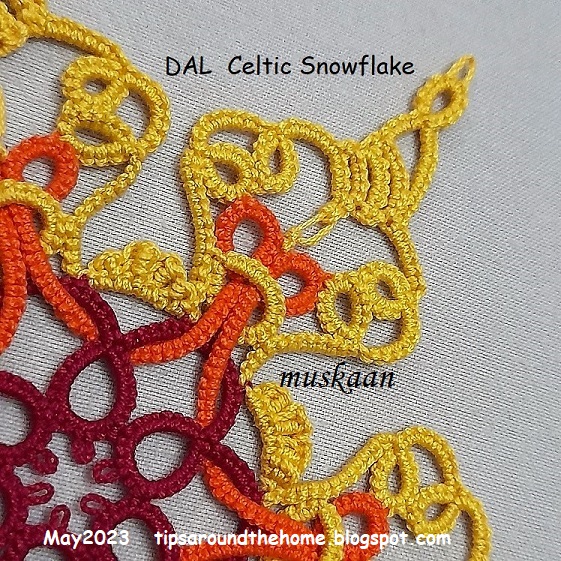
 And the reveal!!!! My version of the 3rd Round design-along for the DAL Celtic Snowflake. This is where I first posted the game - https://tipsaroundthehome.blogspot.com/2023/05/lets-design-round-3.html. My next two posts showed my own dilemma, course correction and solution trial (thanks to Anna Bonelli!). 


Several techniques, effects, stitches, and their modification have been used to achieve this result. 

I am very happy with the end result. I challenged myself and am quite satisfied.

Tatted in Red Rose size 20 threads (equivalent to Lizbeth size 10), the final size is 14cms.
Motif 1 = 4cms ; Motif 2 = 7cms.

I did away with the Josephine rings. For the tip I used a decorative picot; for the treble arches I used graduated treble tat stitches.

This is how it looks in toto. I would've loved to try Sam's visualization of the flake in blues and greens. Hopefully I will do another one in finer threads using the water effect.

To anchor the are thread in the center, after doing a lock join, I made a tied stitch (as in encapsulation) at the very base and then again at the tip. The bare thread is deliberately left uneven to give an open, free-style look.

This is the same, but from the back. After all Celtic interlacing creates a different overlap on the two sides.

Again from the back.


We now have a total of, I think, 15 models submitted or WIP, with 6 patterns (I have to write out mine to make it 7) and 2 more patterns promised. I have started compiling them in a Google Doc but it takes time to get it all done properly since time needs to be squeezed in, LOL.

Please mention the name of the designer and the pattern whenever you post.

Tuesday, 23 May 2023

solution

Pin It now!

 Remember my problem and the mood to give up on my own 3rd round design? Well turns out there were two possible solutions! Anna Bonelli suggested something in Italian which, though lost (on me) in translation actually threw up the first solution to my mind! After making the join I could leave some bare core thread, work and interlace the large ring, then go back and cover the bare thread with 'tied' stitches using the 2nd shuttle!

Anna then tatted a sampler to show what she meant, and that is the solution I adopted. Notice the ring is now horizontal instead of vertical, and I made it smaller too.
Meanwhile I had this idea to use block tatting at the tip. It caught my imagination and between these two elements I allowed my shuttles to do the work, starting with treble tatting arches.
 
I like how the block appears like a flame. 
In several places I hadn't made any picots. Used a finer crochet hook to clear enough space for a join.
To offset any denseness, I did the bare thread thing in the center. I could use dot picot strings, but wouldn't it be overkill?
Just like the Josephine Ring at the tip of the 'flame' is an overkill, right? Although I cannot decide on the JR above the treble tatting arch.
I was going to include decorative picots, but I like the clean lines here.

So what is your verdict? 
I am open to suggestions since I haven't yet started tatting. Oh and this time I'll be using a muted shade of yellow.

So far the design-along has roped in 12 tatters: 1 diagram only; 5 models only (1 WIP); 5 models with patterns; and 1 late starter. I will collect them all in a Google Doc with shareable link so feel free to join the game whenever you can .... 
My journey so far -
Many many thanks to Anna Bonelli for her wonderful solution that got me going!