Showing posts with label folded chain. Show all posts

Sunday, 30 January 2022

who knew

Pin It now!

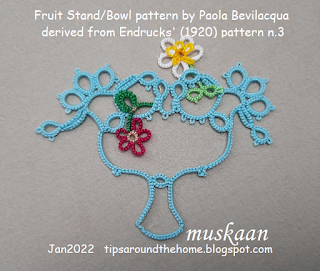
 ... who knew a fruit stand or fruit bowl would emerge from an edging pattern! Who knows what a designer's imaginative eye can see?!
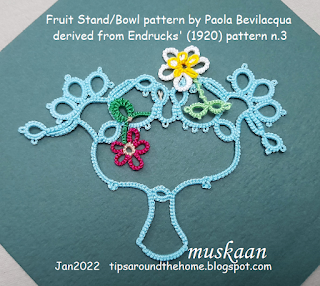
Endrucks' n.3 edging pattern gave rise to 2 square motifs and now the seed has sprouted a fruit bowl, thanks to Paola Bevilacqua. Recently she shared her prototype, with sketched pattern, in our Endrucks 1920 Project Facebook group and the very next day she tweaked the count and posted a beautiful new version with modified count, in stepwise pics and diagram. It immediately caught my fancy and I quickly tatted it up.
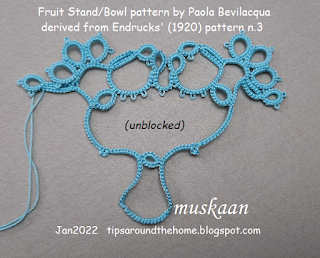
This is fresh off my shuttles, unblocked. And I was trying not to snug the chain stitches too tightly, resulting in uneven lengths on either side. Lesson re-learned: snug tightly; you are no good with loose tension ;-P Or, apply Anita's tip to measure the chain but using a grid paper background to assess the curve as well.
As I worked the motif, so many minor details emerged making me truly appreciate the thought Paola put in!

My Thoughts/Notes -
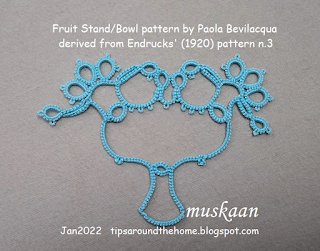
1. I started at the leftmost single ring.

2. Techniques: 2 shuttle tatting, fs/bs tatting, thrown/floating rings, changing the direction of a chain, inward picot, lock join, mock ring using a lock join.

(refer to pic below)
3. Inward picot - the orange arrows show where I used a folded chain to flip a picot down - set-a (picot, 2fhs) and set-b (2shs, p) because I wanted a bit of space before the thrown ring. At other places I used a paper clip.
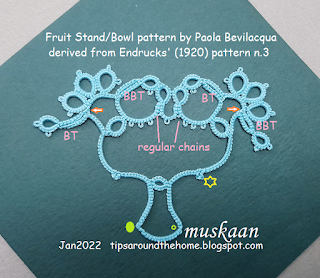
4. There are 3 types of paired chains
    BTworked as block tatting - parallel chains where the new chain lies above the previous one and a lock join is made through picot; 
    BBT: worked as block below tatting - parallel chains where the new chain lies below the previous one and is joined normally through an inwards picot;
    regular chains: where the stitches face each other and the chains are joined normally. Now here's an idea for yet another Block Tatting effect !!!
5. Tiny Mock Ring -The yellow star is another important designer detail. This is a 3ds chain lock joined at the base to form a mock ring. Now if it was a SCMR, we would've had a clear point/break/dip in the chain's inner edge. By using a lock join, the picot creates a kind of continuum with barely a break in the inner edge!
I should add small mock ring to my Mock Ring series since the visual effect is different from that of  larger mock rings

6. Pointed Chain - The small green ring is where I tried to make a 1ds SCMR to create a point, and failed miserably, forgetting that the chain turns course at that point. 
Hence I followed Paola's example for the left one, switching shuttles and reversing/turning work to continue. The point is more marked here. 

In Anchor size 20, it measures 10.5cm x >7cm at the extremes. I rummaged and found these 2 daisy picot flowers to add some colour and density. When I tat this again, I'd like to add lots more colour and picots for a bowl of flowers, and/or strategically placed beads to enhance the effect! 
It could well be a trophy, too, right?!
This is very appealing to applique or glue to a card topper. Otherwise it needs stiffening to hold it's shape. Of course the bowl outline can be padded tatting (either BDS or inserting extra core thread). Perhaps some graduated treble tatting, too, especially at the base!

Many many thanks, Paola, for stretching the boundaries!

Please don't go by my sub-par model.... once we have her permission, we can put her model and pattern in our Project doc here -

Thursday, 11 June 2020

day of the triffids

Pin It now!
What can I say…it’s out of control! The peony just won’t stop growing. Sheetal K on facebook has already made the center (peony wreath) in beautiful earthy tones and has decided to tackle the coaster. She is a kindred soul, eager to learn and work new techniques! Hence this post to share the ongoing pattern, especially since the next rounds are taking longer to finalise….

PEONY pattern continued (Rounds 6 to 8)

Pattern for rounds 1-5 and related Notes can be found in the following posts -

Round 6 was conceptualised and tatted within an hour! No retro-tatting unlike the previous rounds – my guesstimate worked perfectly.
Round 6 –
There are 2 alternating chains, one shorter than the other. Ball and shuttle, continuous thread. Join thread to last picot of previous round such that the new chain will be between petals.
Chain1 : 4 – 2, 4fhs 4shs, 6, lock join
Chain2 : 6 – 2, 4fhs 4shs, 8, lock join
Repeat all around 10 times.
Measures 5”

Round 7 –
Shuttle and ball, ctm. Join to any picot.
Chain : 2 vsp 6 - 3, 4fhs 4shs, 9 vsp 2. lock join to next picot.
Repeat all around, 20 times, joining to previous chain and last chain to the first.
Measures 5¾”
This post was ready a couple of days back, but the pics were not notated. During that time I have almost completed the next round, despite snipping and changing tack! Like I said, it’s out of control, and very addictive!

Round 8 –
Shuttle and ball, ctm. Join to any picot.
‘Peony’ by Pearl Buck
 
I wrote a bit about it here
Chain : 3 vsp 6 - 4, 4fhs 4shs, 4 – 6 vsp 3. lock join to next picot.
Repeat all around, 20 times, joining to previous chain and last chain to the first.
Measures 6½”


So, should this be the last petal round?!
TIP : Actually one can end after any round(s) and create a set of different sized coasters. Only remember to tat the final round without any free picot!

My intention for a final round is to create some foliage that has interlocking rings and chains. But will the shuttle stop tatting the petals, LOL? They tat up quickly once the stitch count is set.

Sunday, 7 June 2020

opening more petals

Pin It now!
Continuing the Peony from my last post, here’s how far I have come. Despite the risk of boring you, it is more efficient to share the pattern for the 3 new rounds, than let my work pile up ;-D Not to mention how excited I am to show the flower blooming!
These 3 rounds, like the previous one, are all dimpled chains, lock joined to previous round. They can be worked in one pass, although I have cut after each round since I am guessing and tweaking the count as I go. Hence if any one round does not work out, I have the option to snip it off rather than unravel it. I haven't had to resort to the former yet.

PEONY (DIP)
pattern continued - Rounds 3 - 5
NOTES -
  1. Folded chain technique is used to create the dimples – a set of 1st half stitches (fhs) followed by a set of 2nd half stitches (shs) creates a beautiful dent.
  2. Although starting each round afresh, I used false CTM, adding the chain thread after tatting the 1st chain, so that the tails are hidden in different chains.
  3. Rounds 2 to 5 can be worked in one pass, climbing out with split chain.
  4. As the chains get longer, ensure the stitches are snugged properly at regular intervals before making the lock join.
  5. I count the lock join, followed by 2nd half stitch as 1 double stitch.
  6. Pattern for Rounds 1 and 2 can be found here

Each round is worked with one shuttle and ball (Anchor crochet cotton, size 20), continuous thread. Attach to free picot on previous round.


ROUND 3 -
Chain : 2 vsp 5 - 3, 4fhs 4shs, 8 vsp 2. lock join to next space.
Repeat all around, 10 times, joining to previous chain and last chain to the first.
Measures 3”

ROUND 4 -
Chain : 2 vsp 10, 4fhs 4shs, 4 – 6 vsp 2. lock join to next space.
Repeat all around, 10 times, joining to previous chain and last chain to the first.
Measures 3½”

ROUND 5 -
Chain : 2 vsp 8 - 6, 4fhs 4shs, 6 - 8 vsp 2. lock join to next space.
Repeat all around, 10 times, joining to previous chain and last chain to the first.
Measures 4¼”

As you can see, I am having too much fun to stop the flower from blooming further! Let's see how far I can take it ....


Pictorials and practice patterns for Interlaced Rings - https://tipsaroundthehome.blogspot.com/search/label/interlaced%20rings


Friday, 5 June 2020

peony interlaced

Pin It now!

Moving beyond linear designs, my next interlacing project is circular. It is still a work in progress since I want to go beyond a single round. I have an idea of what I want, but the exact number of rounds is still a mystery.
And this time there are 4 shades, one in each shuttle. Here’s how I started the first split rings without any knot(scroll down to 'C')

A short while back Anita sent me a photo of her peonies, and I have tried to capture the flower as best I can in the shades I have.
Anchor cotton, size 20.
4 shuttles. Shuttles 1 & 2 have the darker reds; shuttles 3 & 4 have pinks.


Basic pattern :
SR1 : 12 / 11, do not close. Pass shuttle #3 front to back through SR1.
SR2 : 10 / 10. Pass Sh3 front to back again, close both split rings and repeat, joining back to first pair.

Peony Wreath pattern
For a floral effect, as seen in the model, the outermost edge has graduated picots and the pattern is as follows –
SR1 : 1 (–1)x11 / 11, do not close. Pass shuttle #3 front to back through SR1.
SR2 : 2 (–2)x4 / 2 vsp 6 vsp 2. Close both SRs after posting Sh3 again.
Repeat these 2 SRs, joining to the vsp of previous ring, and back to first pair. There are 10 pairs in total.

This can be a standalone project. Add beads and findings for earrings or pendant, or use as a tree ornament. Perhaps a miniature frame? It measures 2" across.

If you wish to continue, here’s the next round with petals….
Peony pattern (DIP)
Folded chain technique or Victorian Sets is used to create the dimples – a set of 1st half stitches (fhs) followed by a set of 2nd half stitches (shs) creates a beautiful dent.

Worked with one shuttle and ball, continuous thread. Attach to space between outer split rings.
Chain : 2 vsp 8, 4fhs 4shs, 3 – 5 vsp 2. lock join to next space.
[Chain2: 2 + 8, 4fhs 4shs, 3 – 5 vsp 2. lock join to next space.] Repeat all around.
Note: I count the lock join, followed by 2nd half stitch as 1 double stitch.

Since the next rounds are going to be in variegated pink, yellow was chosen to break the excess of pink (not a shade I am fond of). However, one can continue with pinks or any colour of your choice, and climb out using split chain.
At this stage it measures 2½” across.

So, what do you think? I’m pretty happy at how it’s shaping out, though there is ample scope for improvement in all areas. But I'll let it be for now. 

Sunday, 4 August 2019

decorating in August

Pin It now!
Snowflake #7 in Land of Laces25 Snowflake Project !

If there can be snowflakes in June/July, why not start with tree decorations in August?!
This Sunday I have 2 tiny stars and a Christmas tree motif for Dorota’s project.

Starlets and MatheMagical Tree  
All 3 projects require only one single shuttle with ball.

The starlets are quick projects to empty shuttles.

Recognise the teal star? Yes, it is the centre from the Repetition Doily. Here are the starlets with the snipped off center. 
I had an idea to use a beaded circle on which this starlet could be anchored, but totally forgot to tat it. Any ring can also be used.

Starlet #1 is a chains-only pattern, starting with a mock ring (SCMR) and climbing out to work the other rounds in one pass. Notice that the outermost chains have their stitches facing inwards. I used a simple picot and folded chain to get the pointed tip.


Starlet #2 is a single round of inward-facing chains with long interlaced picots. In order to get the tip, a small seed bead is moved from the shuttle when required.
Care is required when interlacing so that they move over/under correctly.


Starlet #2 – Ice Drop Process for an ice drop variation is also provided in the pdf.

These make for quick inserts for greeting cards, or to embellish on top of a card. Or as tree ornaments, naturally :-)

Dancing with the stars, all starry-eyed !!!

It is clear from the name that this is a derivation of the snowflake. While tatting the flakes, a single arm looked like a conifer, so I included this in as my #7B, since the starlets are too tiny ;-P
Here, I used green in shuttle, and brown ball.

I made a slight alteration by adding unanchored rings along the center. (If desired, tat 2 rings, one for the front, and one larger behind, for an even fuller look.) 
And picots, of course! 
Picots caused a dilemma! With asymmetrical rings, how to join to the middle picot of each ring since one would have an odd & the other an even number of picots! I solved this by starting and finishing the 'even' rings with 1ds instead of the regular 2ds in the 'odd' rings. Thus I got the same number (odd) picots in both rings and could link in the middle.

Can you see a bell here with slight modification?!

Now here's the deal. pdf for the starlets is ready and link is shared. BUT presenting the tree pattern is posing a problem. I don't need a test-tatter, but can somebody volunteer to look at the draft and answer a couple of my questions and help to simplify it? That is if you think the pattern is even worth the trouble ;-D I
 need to sleep over it some more, yawn, the bell tolls !!!


Monday, 21 January 2019

a gesture of thanks

Pin It now!

It is so heartwarming to see people from around the globe come forward to send positive thoughts and energy virtually and digitally. As a small thank-you gesture, this is the pattern for the awareness ribbon.

When I made it earlier this month (without any direct pattern/reference), I thought I’d come across the body design on pinterest. After a lot of hunting, I finally found it this morning here and here - centre row of a vintage insertion from Priscilla! 

A single page pdf with diagrams and a few suggestions – Positivity Ribbon pattern 
One working diagram is included for transition to next row.
I think it's nice to personalise the ribbon.


TIP : In order to hide the colour blips in the tinted lavender, I used Ninetta’s blipless joinwhich is my go-to on the rare occasions I use such a join. However this time, I counted the join as a complete stitch and I truly like the effect! Can you tell the difference between stitch and join?
Will be using it more often now. 


Techniques I used: frontside/backside tatting, folded chain (similar to folded rings), blipless join.
Both ribbons are worked with Red Rose pearl cotton size 8 ( 20).

This one-pass shuttle and ball pattern could work well as a straight edging or insertion.  But for a bracelet or choker, some tweaking will be required if one wants to have beads on the joining picots. I hope to get around to it....


A slight modification of the butterfly I used on this heart. It has a Josephine ring for head and a lock chain wrapped around for body. All with one shuttle, with a length of thread left at beginning to tat the lock chain.

UPDATE : This pattern is adapted into a hairband - Positivity Hairband.


the support a group provides is priceless !

Thursday, 20 October 2016

truly serpentine

Pin It now!
I had written this post some days back, while still less than halfway through the doily. Didn’t get a chance to either take pics or to notate them and post. Meanwhile, I completed tatting the entire doily a couple of days back. Life is a bit in the way, and that has forced me to break the presentation into 2 posts. Here, I will share my working notes (the Boring stew), giving me time to complete the presentation of the finished doily (the yummy candy).

My Working Notes
for
There is quite a bit of interest in this beautiful doily. Before I start to forget, I’d like to share my working and thoughts ….The doily is not blocked, so please excuse the pics

Abbreviations used (in order of appearance):
SCMR – self closing mock ring
DS – double stitch
RODS – reverse order DS
SLT – shoe lace trick/overhand tie
p – picot
shs – 2nd half stitch
fhs – 1st half stitch
RS – reverse stitch (unflipped)
RW – reverse work

1. Worked completely in one pass !!! Divided into 4 quadrants ; each further divided into 2 mirrored halves (thus we get 8 sectors or pizza slices). Each quadrant (made of 2 sectors) forms one complete repeat.

At this stage it looks like a bull’s head !!!!
2. When considered for the doily as a whole, the overall direction of work is counterclockwise. However, within each sector, we work in many different directions, including ‘up and down’, ‘in and out’. It’s serpentine movement reminds me of the magic square and Iris Niebach’s doilies. 


3. The pattern as such is simple, worked with two shuttles : Rings and chains with reverse work. 4 SCMRs, few split rings, and a few rings made with 2nd shuttle. That’s about it! What makes this doily an arguably advanced or skilled pattern is the movement of the elements and segments – not easy to memorize.

4. If one is doing directional (frontside/backside) tatting, then we encounter ‘blocks’ or segments that act as a “unit” – thus we start with a segment where rings are DS & chains are RODS; then switch to the next segment where rings are RODS and chains DS. Those who have tatted Mary Konior’s Spinning Wheel Glass Mat in directional tatting (or in 2 colours) will understand how one half of the wheel ‘spoke’ works as a unit/block/segment.

5. Exception to #4 : There are also what I consider ‘thrown’ rings (even though they may not strictly be on a chain) ie. rings made with the other/auxiliary/second shuttle. They, of course, will follow the order of the ‘chain’ (RODS or DS)
6. I did add some complexity of my own (yes, I can’t seem to leave well enough alone !) by customizing the placement of colour using Reverse Join or simply laying one thread over the other (instead of SLT. See, I’m not much of a stickler for rules, nor a lover of SLT ;-) ).

7. To turn direction, I used ‘folded chains’ ie., (p, 2shs) or (p, 2fhs). These were included in the stitchcount of the chain (1DS). The folded chain also helps to keep the colour of chain constant.

TIP : In order to fold the chain, I made a picot and continued with the Same half stitch twice, as the last half stitch ; thus there are 3 same half-stitches in a row.
Note that in directional tatting the order switches after folding, because the chain has turned back over itself!
Thus, when folding a DS chain : (p,2shs) , continue next chain with RODS
Conversely, when folding a RODS chain : (p,2fhs) , continue with DS

8. I love the way tattingweed has sketched & notated over the scanned doily with little red arrows showing the direction of tatting – very clear. While tatting, though, I did miss the numbering on rings. Hence, halfway through the 3rd sector, I took another printout & inked the ring sequence. It really helped ! I also added the stitch count for the mirrored Sector 2. in the first printout.

9. There are some rings that need picots, while other elements join there. Due to changes in direction, it was sometimes difficult to tell which ring came first and had the picot. I made a black line on that ring, in the printout. But with the rings numbered in 2nd printout, it was easy.

10. Using Reverse Stitch for chains is another way to keep track of the pattern. RS helps us tat from the front, reducing RW to a minimum. This makes it easier to read the printed sketch. However, if a segment has many ‘thrown’ rings, then RS is not such a convenient option (unless one uses Reverse Rings or Rings in RS!)
As it turned out, I didn’t use the RS much for various reasons. It did come to the rescue in the very last segment, when joining back to the first sector. Here, one has to work inwards, and it became too confusing. When I switched to RS, I could accomplish the tatting and joining all from the front.


Spot treatment

There were a few mistakes where I had to retro-tat the element. But one mistake was discovered very late and a lot of tatting would have to be cut – I had joined a ring to the wrong picot! This called for some minimally invasive localized surgery.
Here’s what I did :
Cleared some space in the ring by moving the stitches and snipped the stitch thread - Not the core thread ; Not the entire ring.
Logic : It would give me plenty of thread at either end when the ring was unraveled.  Luckily it was a large ring and I had more than enough length to sew in the ends to adjoining elements.
Pull the core thread to unravel all the stitches.

Add new thread and tat the ring.
This was also completely knotless method of hiding ends – tatting over tails and sewing in opposite directions to adjoining elements
As I write this, I realize an easier way – I could’ve done a Mock Ring using the core of snipped ring! Waaaaah :-(  Or may be I had already closed the ring and it didn’t seem worth the trouble to unravel it. Memory evades; but nevertheless a solution to keep in mind for future.

As a reward to those who have diligently read through all this, I’ll keep my mouth shut for the most part of the grand reveal in next post, letting pics do the talking. Ummm, at least I’ll try my best ;-p

happy tatting till then :-)