Showing posts with label SQDR. Show all posts

Friday, 23 January 2026

something new

Pin It now!

 For the last several weeks, starting around mid-December, I've been mainly focused on completing the Glossary for the book 'Six T's of Shuttle Tatting' by Net Best. Long back I had divided the glossary into separate letter files for ease of work and have gone through anywhere between 5 to 10 drafts of each over the years. Angela has been a patient and efficient support. This time it is 'final' ... my humble request to the tatting community is "Please stop bringing out new effects and techniques for this year so that I won't need to include it in the glossary ;-P Take a pause, my talented community!" 😁

So anyway, I've been tatting samplers for the glossary which were missing or for new entries. This, and the fact that I need a refresher on a few 'rarely' used techniques, I took up Natalie Rogers' Picot Bingo 2026 challenge again this year after skipping it last year. But instead of a completed project I might only make small samplers - to keep it short and quick. Some of these will actually dovetail with the glossary samplers, thus reducing any distraction or time constraint.

Learnt something 'new' - Stacked Dimpled Split Rings by Sandra Eichelberger (Crazy Mom Tats). It is a very clever application of techniques towards continuous tatting which she shared here - https://psychotatter.blogspot.com/2012/07/how-to-tat-stacked-dimpled-split-ring.html

NOTE: 'Stacked' is used for tatted elements that overlap and/or lay one above the other as a 3D formation. Hence in the present technique, 'stacked' is a bit of a misnomer and is probably used to indicate continuous tatting in a line or row of rings. (Thanks, Mary Arnold)

I used her stitch count. It is like working a split ring backwards where the 1st side is worked after working the 2nd side and the 1st side lies on the right instead of the left. Reminds me of Teri Dusenbury's SQDR (where she started with 1ds and then the entire ring was worked with reverse stitches) or a Reverse Ring, applied here to a dimpled yorkie split down the center.

It was a bit of a challenge to figure out the process but once I got it, it went smoothly. I think a pictorial or a video would help a great deal.
TIP: The main thing to keep in mind is to make the mock picot long enough. Notice how the dimple in the 2nd heart from top is less pronounced? The fault lies in a short mock or false picot.

Tied in a quick tassel made from the first scrap threads I could get my hands on. So one more tatted bookmark in my stash, though the body could've been longer.
The boxes crossed out in the Picot Bingo 2026 game (Level 2) -
  • Dimpled Ring - I'm sure these count even if they are split.
  • Tat a Rings Only Pattern - why do we limit ourselves to vintage rings only style patterns, LOL?
  • Tat a Heart - five hearts here.
  • Mock Picots - gravely important in this pattern/technique!
Two different levels of cards are shared by Natalie although I believe the above project falls in a bit of a higher category than even Level 2 (wink, wink). Check out the details and downloads here - https://www.patreon.com/posts/happy-new-year-147124370

UPDATE: (31 Jan 2026) Jane McLellan had worked on this technique to create a bookmark and a beaded bracelet here - https://janemactats.blogspot.com/search?q=stacked+dimple+rings
Many thanks to Sandra and Natalie !!! Keep it interesting and challenging! Great opportunities for new learning and consolidation of past learning.

Thursday, 20 August 2020

dandy options

Pin It now!
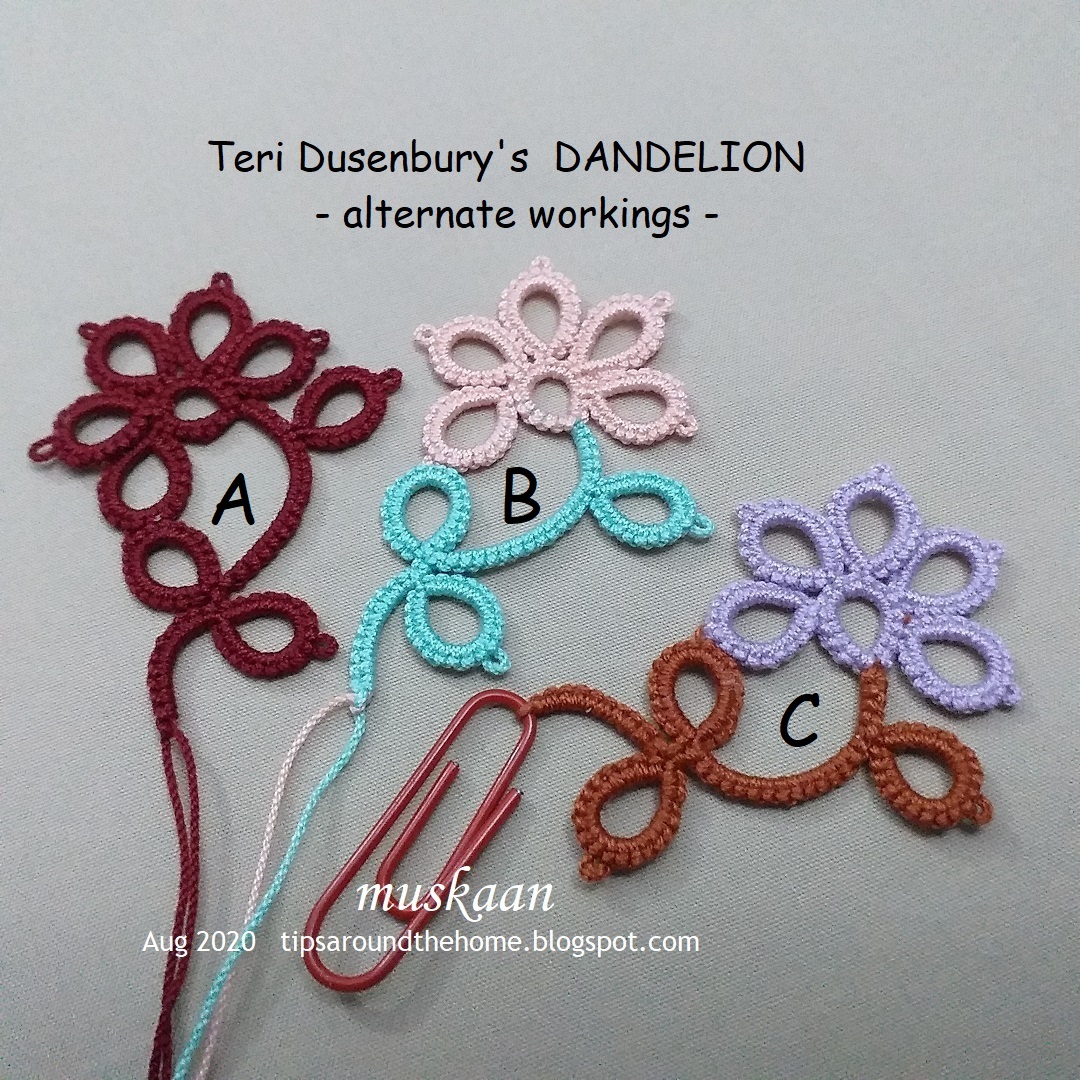
 Solai S asked for help with Teri Dusenbury's Dandelion Chain Link Bookmark after seeing a few recent versions inspired by mine. I needed to refresh my memory by reading the pattern and my blog notes. Huh, turns out I already had the SCMR in place of SQDR idea back then. Time to test it!

SQDR = split quadruple directional ring. It is basically a split ring but has only 1ds on the first side and the rest is worked on the 2nd side, using reverse (unflipped or larks head knot) stitches. Working moves counterclockwise. Rings thrown off the center are worked with same shuttle without any switch. 
If shuttles have different colours, there will be 1ds (on 1st side) that will of one colour and the rest in 2nd colour.

SCMR = self closing mock ring. This is a chain that closes into the shape of a ring. Working moves clockwise, and rings can be thrown off by switching shuttles.
It makes no difference if shuttles have 2 different colours - the entire SCMR with thrown rings will show the same colour stitvches.

The post is long because I am showing 3 alternate methods of working the Dandelion motif, all using the SCMR instead of SQDR. A lot of tips are also thrown in, giving the tatter an opportunity to pick and choose steps as desired. Feel free to skip the working you do not intend to make. 
And for even more options on ways to tat a central ring with several thrown rings, read the article, and download the tabulated pdf. 

 
Note that since thrown rings in SCMR are worked from left to right (a to e, in above left image), the start and end stitches of the SCMR are as notated. It may also be a good idea to make the motifs first, then make the chain link surround (the black rings in above bookmark), joining on the go.
Please follow the original pattern for stitch count and instructions, making necessary adjustments. The following is merely a depiction of alternate methods of working and/or using 2 colours. And knotless starts.


ASingle colour, 2 shuttles, wound ctm (continuous thread), SCMR with thrown rings.

Red - shuttle #1 ; Yellow - shuttle #2

 
A-1 : Loop Sh2 as if starting a chain. Bring Sh1 around the pinky once .... 
A-2 : ... to hold open a loop of Sh1 and start SCMR with 5ds.

 
A-3 : Making the 1st thrown ring with Sh2.
A-4 : Closing the 1st thrown ring off SCMR

 
A-5 : Follow pattern to make 4 more thrown rings, finish SCMR with 3ds, and close the open loop after passing Sh1 through it. Continue with stem using Sh1 as core and throw off the next ring.
A-6 : Follow pattern to complete the motif. Notice there are 2 tails that can be hidden in the chain link later.  
TIP : For a standalone motif, and to avoid sewing in tails, hide one tail in the last stem ring, and tat the final segment (10ds) of the stem as a floating chain as I did here for the rose
Tutorial -  https://tipsaroundthehome.blogspot.com/2015/03/dead-end-start-to-split-chains.html

The tails in above motifs are not hidden in order to keep my options open for future.

B. 2 colours, 2 shuttles, SCMR with thrown rings    

Red - shuttle #1 with teal thread ; Yellow - shuttle #2 with pink thread  

  
You can start by knotting the threads. I prefer a knotless start, tatting over tails in separate elements.
B-1: (left image) I usually cross the threads as seen in left image. Each tail is hidden in a separate element.
(right image) This time I simply placed the tails one above the other and continued as below.

 
B-2 : Wrap the threads as above, holding a loop of Sh1 open.
B-3 : Work 5ds of the SCMR, tatting over tail.

 
B-4 : Switch shuttle and work the st thrown ring, switch shuttle to work the SCMR stitches,....
B-5 : and continue to make the rest of the thrown rings and 3ds to complete the central ring.
TIP: Notice how I inserted the pink tail inside the open loop, and also passed Sh1 through the same loop.
 
B-6 : Now close the loop/SCMR. But for Version 2 of pattern, we need switch threads for green stem stitches.
B-7 : The most common solution is SLT (showlace trick). I prefer to avoid it. Instead I did TwW (twist work) as in this bookmark. With Sh1, make an unflipped half stitch, but while tensioning, ensure that the shuttle moves to the top, thus repositioning threads and shuttles into desired positions.

 
B-8 : Work the chain with Sh2 core (hiding the pink tail), thrown ring with Sh1, and chain with Sh2 again. At the end of this segment, TwW to switch shuttle positions.
B-9 : Continue and complete the motif. The tails can be hidden in the chain link later.


C2 colours, 2 shuttles, SCMR with thrown rings, starting from bottom, ctm 
Red - shuttle #1 with brown thread (and later with lavender) ; 
Yellow - shuttle #2 with brown thread 

C-1 : Wind Sh1 with stem thread; pull out a length from the ball and cut. Pass this end through the respective chain link ring (if you make this frame first, as per original pattern), and wind the rest on Sh2. Thus, we have joined, with no tails to hide at the start. 

In my standalone model, a picot space is held open with a paper clip (dead end start). Thus, if the motif is worked first, this paperclip picot can be used for joining to the chain link frame.
Work the stem and leaves.
C-2 : Snip off the Sh1 thread, leaving a tail (the shuttle at the bottom of pic) which can be hidden under any element. Sh2 becomes the core thread shuttle for SCMR. 
Wind lavender on a shuttle, tat over tail to hide end and work the SCMR with thrown rings as per pattern. (add thread on chain)
C-3 : Close SCMR and hide ends.


It's been over a week since I heard from Solai, and have no idea whether she has started the bookmark and has any issues. But this seemed like a good opportunity to try out the substitution idea and share with you. 
So, pick up your shuttles and get started :-) What colours will you use?

One more question - do you like the size of the images? Any changes you would like to see in the presentation?

Thursday, 28 July 2016

refresher

Pin It now!
The weather calls for frequent cool refreshments; my memory calls for frequent refreshers !
This post is a refreshed version of my previous post where I had a posted a hasty response as update. I was not fully satisfied. 
Reason : I had tatted the SQDR in 2014 ; then the RR in 2015 ; and was writing the post in 2016. During the intervals neither of the two techniques were used. High time for a refresher course, right ?! And I needed to confirm my explanation/comparison. 

This time, trial tats are included for easy comparison.
Also, as I hunted online, I found a few more tutorials/videos. Incidentally, I had already tatted samplers of some, & only later found that videos were already online. So here I go again ….

Practice Pattern Used :
SH1 – pink ; SH2 – shaded green.
2 colours used for clear distinction. Variegated thread gives more idea of the direction & progression.
I start with a 1” long lock chain to show clearly where the threads emerge after central ring is closed.

Disclaimer : This is not a tutorial but a collation/annotation of methods, with a few trials thrown in. The terminology, origin, & collection is limited to and limited by the knowledge & comprehension of the blogger, and to the resources consulted to date.

Common threads Set II : Rings On Ring
or 

The traditional method of tatting the ‘daisy medallion’1 is to make a central ring with picots, then cut & restart the next round, or climb out with a mock picot. The next round consists of rings that are joined at each picot either at their base when using single shuttle (with bare thread between rings) or at their tips with chains between adjoining rings when using shuttle & ball.
But tatters have long since hit upon ways to tat rings directly on the central ring. These are called thrown off rings, thrown rings, or floating rings. No picots or second round  required – all tatted in one pass. The thrown rings can also be Josephine rings.
I was interested in seeing whether one can throw multiple rings off a central ring, yet emerge out at the starting point. There seem to be at least 4 main ways to achieve this goal :
  • Loop Tatted Ring on Ring
  • Wrong-Way Tatting or Reverse Ring;
  • Split Quadruple Directional Ring  aka Ring Off Split Ring;
  • Mock Ring or Self Closing Mock Ring

I continued the experiment a bit further, branching out to separate exit points or using 2 different ways to throw rings off the 1st side of a split ring. But these are off-shoots of the above set. One can also tat the central split ring using Dora Young Method and throw rings off it2, but it is rarely used for SRs any longer. If one is working with a single shuttle, then this can be an option.
I must also admit that with the ease of tatting a SCMR, many of the other methods have limited use.
A 3-page pdf includes the 3 pics above. Click here to download pdf
Since it is all tabulated/notated, I am restricting textual explanation here to comments/pointers & some tutorial links.

1. Loop Tatted Ring on Ring (LTROR)

Most useful when tatting with a single shuttle.
Some dexterity with finger-tatting is required (although loop can be inserted into a shuttle temporarily). 
Size of central ring & number of thrown rings are limited since the central ring is a true ring.
LTROR with pattern by Sabina Carden-Madden 2008 , diagrams by Jane Eborall 2012 and diagrams by Jane Eborall and by Anastasija P. Yelisejeva 2012 , video by Karen Cabrera 2013


2. Wrong-Way Tatting or Reverse Ring (RR)


Tatting direction is opposite to that of LTROR, and central ring is tatted with reverse stitch instead of double stitch. Core thread differs from stitches, hence 2 shuttles required. Care must be taken when starting the ring. Limitations similar to LTROR. 
This method of tatting may be ‘normal’ for left-handed tatters.
Rebecca Jones' 1985 book 'The Complete Book of Tatting' calls it Method Five - Wrong-Way Tatting (p26)3; Ruth Perry's Tatted Reverse Ring with Rings Thrown Off video & her RainBeau hedgehog pattern 

3. Split Quadruple Directional Ring (SQDR) or Rings Off Split Ring

The central ring is a split ring, with thrown rings on the 2nd side. If the 1st side has a single DS as in this pattern, then the threads exit almost at the starting point as in LTROR & RR. If both shuttles have same thread, the split is almost indistinguishable. Teri Dusenbury 1998 named it SQDR, with instructions & pattern. This term has been substituted by the Ring on/off SR - diagrams by Jane Eborall 2008, and video by Karen Cabrera
The 2nd model on right side has more DS on 1st side for comparison, but notice the exit of threads. 

Loop Tatted Ring on Split Ring (LTROSR) 
Major limitation of Rings on SR is that thrown rings are made only on the shuttle2 side.
This limitation can be overcome by throwing LTR (loop-tatted rings) on side 1, as seen below, But threads will exit from a point other than the starting point :
See also MROR below.

4. Mock Ring (MR) or Self Closing Mock Ring (SCMR)
This technique has solved all problems or limitations of above techniques. Rings can easily be thrown anywhere around the central ring; both central & thrown rings can be as large as one wants; the threads will emerge at the starting point; all tatting is from front in clockwise direction, using only DS.
The only limitation is if one wants thrown rings in 2 different colours.
Mock Rings have been around for over a century4, although SCMR is a relatively recently coined popular term. Diagrams by Jane Eborall 2008

Mock Ring in Split Ring (MROR)
I have included this method to compare with LTROSR. It uses MR to throw rings on side 1 of a central SR, although strictly speaking the threads will not exit at the starting point ...
 
Interestingly, side 2 is tatted first, then side 1. Multiple rings can be thrown on side 1 of the central ring, but the multiple loops are difficult to control. Moreover, since the loops remain open till the very end, size & number of rings need to be curbed. Requires quite a bit of practice, but if one single thrown ring is required, this can be adopted. 
diagrams by Ninetta Caruso 2012,  as well as stepwise pictorial with tatting ; video by Karen Cabrera

Here are my trials with the MROR ... even with these many trials, I could not control the shape & the central ring tended to lose it's curve.
Tried multiple little tweaks & kept referring back to the pictorial, diagrams & video. Finally I have come to 2 conclusions : the thrown ring has to have a certain minimum stitchcount for a good shape & control ; it may not be advisable to have a large central ring, or multiple thrown rings. One medium to large MR on a SR is ideal for me.

To Summarize :
This compilation has explored the various choices one has. But with the ease & scope of a SCMR, this has become a bit of an academic exercise. Notwithstanding, each technique can have it's advantages in specific situations, to get out of a tight corner, or for a designer.
How one chooses a particular technique of a combination of one or more, may be determined by :
  • pattern requirement,
  • colour placement when working with 2 colours,
  • size of central ring,
  • number of shuttles being used,
  • number, size & position of thrown rings,
  • exit or climbing out point(s) of threads,
  • skill & comfort level of tatter. 


Phew !!!! Hope some of this is helpful to someone ! free pdf download

happy tatting :-)

1 Elgiva Nicholls' 'Tatting: Technique & History' 1984
2 discussed by Patty Dowden in this Craftree thread
3 cited by Judith Connors' in this Craftree thread
Judith Connors' An Illustrated Dictionary of Tatting'

Related post : Ring with Thrown Rings

Friday, 22 July 2016

the hedgehog turns !

Pin It now!

The Hedgehog Turns !
(tatted on July 28, 2015)
While deep into the Cluny Tatting series I posted last year, some relaxation & distraction was in line. 
It came in the form of this cute hedgehog pattern that I first saw on Craftree, here . What drew me to the pattern was the use of Reverse Ring (RR) . I hadn’t done this since my first time in Teri’s Dandelion ChainLink Bookmark ! High time I tried it again. (In 1998, Teri called it the Split Quadruple Directional Ring (SQDR).

And sure enough I had forgotten ! SQDR or RR is tatted all from the front, including the thrown rings that emerge from it. But I used reverse order stitches in the thrown rings. That’s how the hedgehog turned !!!

Ruth Perry (Rozella Linden) 
Materials :
Anchor Mercer Crochet Cotton Size 20. Shade White w/ Tan 4054-1218
2-shuttles CTM.
It measures approx. 3”x 1½” 
Techniques used
SQDR or RR, fs/bs tatting (RODS), decorative picots, thrown/floating rings, padded double stitch, SLT (or turn work/folded chain or direct tatting) , split ring, lock join.
Abbreviations :
CTM - continuous thread method of winding 2 shuttles
LTROR – loop-tatted ring on ring
pds- padded double stitch
RODS – reverse order double stitch (as in frontside/backside tatting)
RR – reverse ring
SCMR – self-closing mock ring
SQDR - split quadruple directional ring

My Notes
The central ring can be tatted in at least 3 different ways:
i.         SQDR / RR (remember to tat from front only & post shuttle 2 before closing ring)
ii.       Mock Ring ( preferrably SCMR) with thrown rings
iii.      LTROR (loop-tatted ring on ring) 
We are quite spoiled for choices :-)

As mentioned above, I tatted the thrown rings in RODS. Decided to continue with RODS in chains, resulting in a hedgehog that faces the opposite direction to the one in the pattern ! This pic shows the hedgehog from the back side.

Added more picots for a fuller spinier back. At one point I thought of making twisted picots (floating) but wasn’t in mood to do the twist. 

I most probably skipped the SLT for snout. Either made a folded chain (vsp, 2 half stitches) to turn the chain; or I may have switched shuttles for direct tatting (reverse stitch). I don't quite remember after 1 full year.

Used padded double stitch for tail : 1pds(3,3), 1pds(3,2), 1pds(2,2), 1pds(2,1). Tie & cut.
Basically, 4 padded ds with decreasing number of wraps .

I could’ve added a black seed bead for eye. (shown in the pic is a painted black eye).
The piece is unblocked - fresh off the shuttles.


Many thanks to Ruth, for sharing this cute & fun pattern


happy tatting :-)


I'm on a tatting-free break for the past week in order to recharge my batteries. Yes, there is a whole backlog of posts (projects, tat-alongs, tutorials) & tatting to accomplish, but it was getting stressful & slow-paced. I am, however, taking this opportunity to upload some such old projects & reduce the backlog a tad.

update : 
This segment is in response to a question in the comments below.
It is a quick post, & limited to my understanding at this point in time. Hope there are no errors !
common threads - SET II 
Ring with thrown rings

I have included 5 techniques by which we can have thrown rings on a ring : SQDR, RR, SCMR, LTROR.

What is Split Quadruple Directional Ring (Teri Dusenbury) 
or Reverse Ring (Ruth Perry) ?

(( Direct tatting aka reverse stitch, wrapped stitch, unflipped stitch, hitch, encapsulation, 2nd half of split ring stitch. ))
  • I learned Split Quadruple Directional Ring SQDR from Teri’s instructions & diagrams which form part of her bookmark pattern. Can perhaps be called Split Ring with thrown rings or Rings off Split Rings. 
  • I don’t have Ruth’s tutorial or instructions for Reverse Ring (RR). But her RainBeau hedgehog pattern instructions/diagram seemed to suggest that it was very similar to SQDR.
  • So what is SQDR or RR ? It is a ring worked with direct tatting or like the 2nd half of a split ring.
  • We start with a loop of SH1, but use SH2 to make the unflipped stitches, thus moving in a counterclockwise direction.
  • Rings can be thrown off this central ring, using SH2.
  • The entire central ring can be completed in this fashion & it will be a RR, as in the hedgehog above.
  • The central ring can be started as a split ring (SR) & then worked in direct tatting, making it a SQDR. (in this case, rings can also be thrown off with SH1 on the 1st side of SR), as in the Dandelion ChainLink bookmark pattern where the first part of central ring starts with a single double stitch. The rest of the pattern is worked as a reverse ring with thrown rings.
  • In both cases, we are tatting True Rings.
  • We need to remember to post the shuttle through ring before closing it.
This video of Rings off Split Rings by Karen Cabrera will give a very good idea of how to work such rings, and the possibilities can be visualized.

  • We can get the same effect using SCMR, which is perhaps easier if one is not used to direct tatting. In Self Closing Mock Ring, the central ring is a Mock Ring - a chain, from which rings can be thrown off. It is worked in clockwise direction, with normal Double Stitches. And we need to post the shuttle through the loop left at the beginning, before tensioning it. 
  • In SCMR, all thrown rings are limited to SH2 (as in RR).

  • Another technique where we can throw rings off a ring is Loop-Tatted Ring on Ring (LTROR)

I came across this term & tutorial/diagram from  Anastasija P.Yelisejeva
In relation to the above : It is a True Ring. The thrown rings are also true rings, tatted using a loop pulled out from the ring loop itself. Tatting follows a clockwise direction
I used LTROR for part of Iris Niebach's doily It has an added advantage of being naturally blipfree, unlike a SCMR.
Another advantage : these can be worked with a single shuttle.
Karen's video for LTROR

To Summarize :
  1. In all the above 4 methods, multiple rings can be thrown all around the central ring. And when the central ring if finally closed, the thread(s) emerge at the base/start. 
  2. SQDR & RR are worked in counterclockwise direction, and we need to tat the thrown rings from the backside of the work ; LTROR & SCMR are worked all from the front, in clockwise direction.
  3. SQDR, RR, SCMR require 2 shuttles ; LTROR can be done with single shuttle & finger tatting.
  4. SQDR, RR, LTROR are true rings ; SCMR has a central mock ring.
Which technique one chooses will be determined by ...
  • colour placement, when working with 2 colours 
  • skill level, 
  • pattern requirement, 
  • number of shuttles used, etc.


all about the padded double stitch
LTROR in Niebach doily, with notes
SSSR with thrown rings in Sunshine Snowflake Lace
Common threads Set I