Shadow Work / Chikankari Embroidery
on Organdy Saree
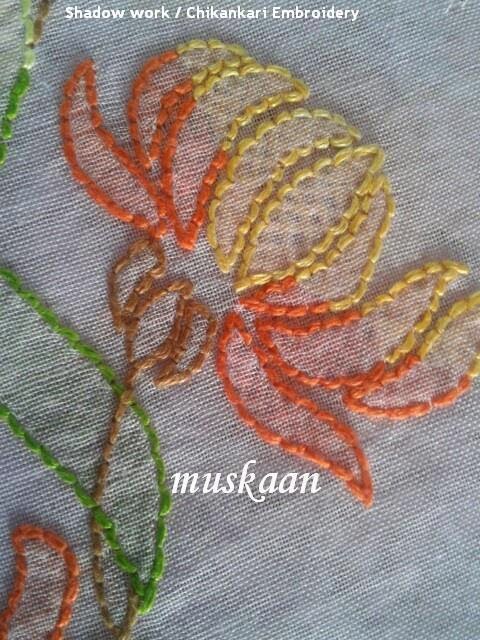 |
| Extreme Close-up of part of motif |
Time to take a mini break from blogging about tatting
:-p
Please excuse the poor quality of photos. These were taken 2 years back when my photography skills were worse.
Please excuse the poor quality of photos. These were taken 2 years back when my photography skills were worse.
Thread used : Anchor Embroidery Threads (Anchor cotton floss) in brown, dark purple, & 2 shades each of green, yellow, orange, blue.
Strands used : 2 strands.
Stitches used : This is in the style of Lucknow Chikan embroidery or Chikankari, also called Shadow work or Shadow stitch. It appears like a parallel row of Back Stitch (or Double Back Stitch) in the front, & Closed Herringbone Stitch when seen from the reverse side.
Back stitch
Eyelet Stitch / cutwork (with couching)
Single
Motifs


I altered the original pattern just a tad, moving & realigning the lower left flower to the top, so as to get a continuous trellis when repeated.
Thus each
motif consists of 4 flowers lined up in decreasing size.


In the pallu area, each motif is used separately, with a different colour (yellow, orange, blue),
in sequence. (This sequence was maintained throughout the saree).
I think I did 3 motifs per row, with a phase shift between rows, & 4 rows in all.
For the pallu edging, I added a very simple scalloped braid using purple shadow work


For some shading, since there was no variegated or shaded thread, I
used 2 solid colour shades (light & dark) in some petals.
Trellis


The same motif was mirror-imaged & alternated to create
a long trellis of 4 repeats.
Flower colours are alternately used, within each
repeat (yellow, orange, blue).


Flower colours also alternated between trellises. So if one
trellis started with a yellow flower at base, the next trellis started with an
orange & the 3rd with a blue, repeating this sequence. I made 7 or 8 such trellises, with these motifs
climbing up to ¾th the width of saree, at a slight angle .
TIP : While
embroidering a colorful pattern/design, use multiple needles, each with required
colour, for quicker & easier work.
I even separate
the skeins & cut out the desired lengths beforehand, knotting them at one
end & winding them around a piece of cardboard/bookmark with a slot at one
end to keep the threads from flopping around & getting all entangled !
Stitches


Added a tiny cutwork area in centre of large bottom ring,
surrounded by purple thread. I did this in the Lucknow Chikankari style/stitch
or the Eyelet Stitch, not blanket stitch, using only a single strand
of thread here, with very close stitches couched over a running stitch.
 |
| Upper end of one Trellis |
I used Back stitch, instead of Stem stitch for the stems, to
keep the work in sync
with the shadow work (double back stitch) outlines.
Everything was embroidered from the front side .
View from the Rear !
 |
| Extreme close-up of reverse side |
I actually prefer the reverse side of shadow work to the
front side ! As it is, if asked to choose a single favorite, my all-time go-to filler stitch would be the closed Herringbone stitch.
Pics from reverse side show how I went about
the 'shaded' effect. using only single-shade threads.
And I like to keep
everything neat - front & back ;-)
After each knot, I tuck/weave the thread
under some of the stitches to keep it neat And durable.......
Even after 2-3 years’ usage, none of the thread ends
have slipped out. Neither are the thread ends & knots visible.


I tried to avoid long crossing-over threads for fear they
might show on the right side,
as well as to prevent accidental snagging.
If it
was necessary, then usually the thread was woven back through stitches,
to a
point where the ‘carryover’ would be a much shorter distance.
This can be
accomplished easily enough : study the motif carefully & decide on the best
place
to start with minimal carry-over threads & smooth flow of embroidery
between petals.
Thread
What I could not capture in my limited prowess with
photography, was the pale purple/lilac of the saree & the rich elegance of
the thread.
I love Anchor threads ! These are colourfast, retain their
elegant, understated sheen even after long usage & many washes (these pics are after 2-3 years’ usage),
easy to work with. Have been using them since the day I learned to embroider,
with no complaints whatsoever !
This sari, a gift to my MIL, was embroidered almost 5 years
back when I still had normal vision !


