Showing posts with label decorative picots. Show all posts

Saturday, 21 March 2026

Dedicating my 1000th

Pin It now!

For this 1000th post I kept musing on the choice of subject. And I finally decided to dedicate it to some of my favourite people who have shaped and inspired my tatting journey. This is a symbolic gesture to ALL the tatting teachers, designers, innovators, experimenters, explorers who have shared their own learnings and experiences. 

Three Geniuses and a brand new stitch in tatting!

Two years back I stumbled upon two drawings that gave Ninetta Caurso's treble tatting stitch a basis in tatting history! 

A drawing on page 31 in Anne Dyer's 1994 book, To Boldly Go Where No Shuttle Has Gone Before, showing the decorative chain picots. 

A drawing on page 85 in Rhoda Auld's 1974 book, Tatting: the contemporary art of knotting with a shuttle showing her twisting the thread (this twisted picot is something I had pointed out in my pictorial) and passing the shuttle through it. Her tatted model is what we now call the vapour stitch.

Well, our very talented Ninetta engineered the two movements to create her treble tatting stitch (tds) all on her own! At the time she did not posses either of the books and till I pointed it out to her, she had not noticed! Basically, the chain picot became the 1st half of the tds while the vapour stitch became the 2nd half of the tds! 

💧One of the reasons for the delay in posting this was ambiguity about whether I could share the diagram pic from the book with due credit. Anita suggested I ask Tamie Montgomery, who now runs The Online Tatting Class and is very mindful of such issues. She was very receptive and we discussed it. Although she said it was okay to use the accredited pics (like Georgia had done) since it was a 'technique', I still wasn't comfortable, till I hit upon the idea of showing it in thread as above. 

💧💧💧

Auld is gold bead effects!

Last year I found some new beading effects by Rhoda Auld in the same book and took the liberty to give them each a name based on words used by her.

Framed Bead - The diagram on page 107 has been in circulation through Georgia Seitz's classes for several years now. Georgia pitched it as a way to add a bead in the center of a ring and I used it in this butterfly


However, Rhoda showed it as a way to add a free bead on a long picot with bare thread framing the bead on both sides when slack is removed. Makes for some good possibilities.

Piggyback Beads - Now this was fun to discover! On pages 99-100 Rhoda shows how to place two free beads one over the other using simple movements. I tweaked it a bit to make it easier to tat.
Instead of loading the bead on the core thread where she has to move the chain stitches, I loaded it on the knotting thread (teal in above sample) and the rest of the process remains the same. On an earlier page, Rhoda makes the teal picot longer and ties up both picots till required for joining. Hence there are many options depending on the pattern.
My sample is a bit wonky, but you get the picture, right?
💧💧💧

Generosity knows no bounds!

💧I can't thank Anita Barry enough for gifting me so many vital books on my list. Without these I wouldn't have been able to review and edit Net Best's, Six T's of Shuttle Tatting, not with any satisfaction or confidence. These have helped me to confirm, correct, or refine terms for her glossary, and even understand and discover so many gems, some of which I took the liberty of adding to the glossary.

💧Judith Connors has been taking an active interest in the glossary, too, either as an answer to my question, as a reaction to my blog post, or reaching out on her own privately. You can imagine what a treasure trove of knowledge she is and how lucky we are to benefit from her skills. 

Judith sent me a copy of her 2000 book, Creative Tatting with beads, shuttle, and needle. It has some of my all-time favourite patterns besides numerous interesting effects and applications. While I read the book, tatting models will be later in the year. 

💧Late last year I received a wonderful digital book by Carin Jansen, Riego ReTatted (2023).  She needed some advice on selling the book through the USA, not being sure of its reception. With permission, I sought Anita's advice and we both gave our respective take urging Carin to put it on the market. Eventually she decided against it for personal reasons, though she has shared her Dutch version within her group. It is such a labour of love and we hope she will change her mind in future. Carin has chosen patterns from each of Mlle Eleonore Riego's books (1850-1886) and shared detailed steps and modernised versions/tips in a pleasant format alongside diagrams and written patterns. 

💧💧💧

I'd like to think that my blog has stayed true to its name to the extent that almost 95% of my posts have a tip of some kind. Unfortunately I couldn't stay true to the url since this blog soon turned into a tatting blog ... not that I'm complaining, LOL. 

Hope you continue to follow my blog and read my posts. 💞

You will find tutorial links to terms in this post here - https://tipsaroundthehome.blogspot.com/p/tatting-resources.html and you can use the search box on the right panel to look for past posts on the tags used here and much more.

💧💧💧

Many many thanks to all the wonderful tatters mentioned here and also to those not mentioned who have influenced, inspired, and improved my tatting journey and maintained my eagerness to blog.

Saturday, 24 August 2024

on the fringes

Pin It now!

 Or not so much on the fringes? 

FRINGE(s) is a kind of decorative edge made of lots of hanging threads.  

FRINGE TATTING usually involves very long adjoining picots at the outermost edge of the piece, which are then cut and trimmed to size. These may be frayed if needed. (thanks to Anita Barry, who also shared a pic for the Glossary)


TATTED  FRINGE  AND  ADAPTATIONS -
Then came the Tatted Fringe shared by Corina Meyfeldt in November 2015 here - http://cmhandmade.blogspot.com/2015/11/fringe-sort-of.html . 
Unlike the former, the tatted fringe requires an auxiliary or spare thread.
She first tatted a chain with long adjoining picots on the main core thread; then snipped and trimmed the picots, spread them out and wound the shuttle to start the project. Snipping the picot tips separates the individual stitches.  Corina brought forth each fringe from the core thread as required. 

Tatted Fringe on Picot -
Notice that in the above WIP ring, I placed some of the fringes on the ring loop or left-hand thread while others remain on the shuttle thread. Thus we have the option of placing the fringe on the picot as well as on the core. Just like one would do for beads!

The above tatted fringe (made of metallic thread) is positioned on both the core as well as picot threads.
An extended application of Corina's method.
This can be done on rings as well as chains and gives a thicker fringe.

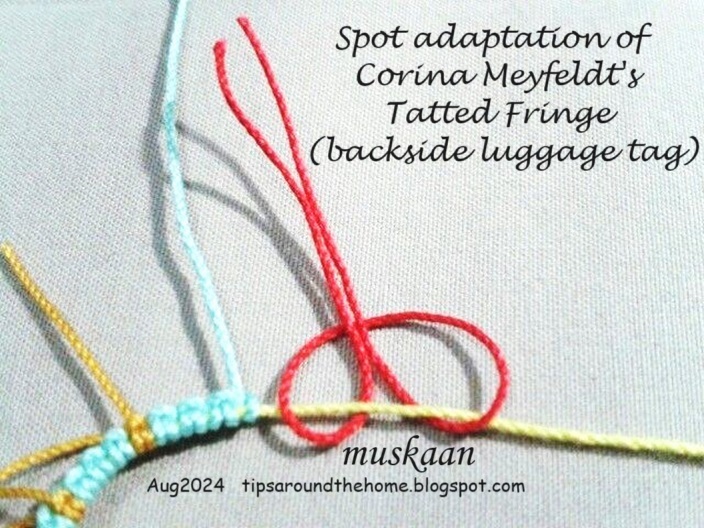
Spot Adaptation (using luggage tags) -
In December of the same year I shared my spot adaptation, with pictorial, here - https://tipsaroundthehome.blogspot.com/2015/12/fringe-benefits.html
Instead of tatting a chain of long picots, I used luggage tag loops to make a lark's head knot on the core thread wherever and whenever required. These scraps can be tied frontside or backside (see next pic).
Besides, we have the freedom to include as many colours and threads as desired. Again, though not shown, the tag can be tied to the left-hand thread (on picot) or the core thread.

Seen together on a chain. Look closely and you will see that I brought the left-hand thread over and between the luggage tag, thus securing the fringe. 

NOTE: Since the tatted fringe makes a stitch on the core thread, care must be taken with the total stitch count in a pattern not written for a fringe. 

Tatted Fringe Picot! -
Now this is probably something new. Or at least I haven't come across it yet.
Since I had a few fringes left on the shuttle after tatting the first sample, I tatted a second ring but put all the fringes on the loop around the hand. And made a picot! 

UPDATE (Dec2024)
BEADED FRINGE - aka Beaded Stem (Corina Meyfeldt) and Single File Beaded Picot (Nina Libin)


So, that's all for now folks. Editing (and tatting samples for) the book Six T's of Shuttle Tatting, by Net Best, is taking me to the fringes of the tatting world and tatting literature! It is making me delve deep and wide and sometimes inspiration strikes and I go off on a short explorative excursion. Hope you enjoyed this short journey and can find some applications for these fringes. And if you have any new  technique or effect, please let me know so that it can be included in the Glossary. 

Thursday, 25 July 2024

multifascination

Pin It now!

 This time I have not delayed, not by much essentially. A couple of months back I came across an Instagram post on tatting and their profile said they were a German group of 15-20 members with a common passion for occhi! I messaged them about our Endrucks 1920 Project and so began a lovely friendship with Elisabeth Dobler (she manages the account and is the founder of the group 'Occhi Freunde Oberschwaben'), a very talented tatter who enjoys pushing the boundaries and exploring new techniques.

Inspired by my E25 palm leaves, she belted out a range of effects from one basic model! We decided to call these Multifaceted Leaves. She graciously accepted to share the pattern and we worked together to create a presentation that is hopefully clear and easy to follow. She also made a presentation in German. Here are the links to both -
E24 Multifaceted Leaves by Elisabeth Dobler - https://drive.google.com/file/d/1ywaZcQP8b1M86jo4yLIwpH5fZ5kQ0_tX/view
E24 Facettenreiche Blätter by Elisabeth Dobler - https://drive.google.com/file/d/1-uFBNdM9aFOPUDCJyWC_dy1R_nyC4KRw/view
 
Multifaceted Leaf #1 (basic) 
This is the basic pattern which can be embellished as desired. She has worked the leaves in a clever and interesting fashion, entailing encapsulation. 
While the detailed pattern for this basic leaf is given, for the others an explanation of the effect/process is provided. Instead of repeating the description here, I request you download the pdf and understand the intricacies.

Multifaceted Leaf #2 - 
She has used metallic thread to embellish the leaves.

Multifaceted Leaf #3

Multifaceted Leaf #4
Maltese Rings adorn this leaf.

Multifaceted Leaf #5
Here the leaf starts at the mekik oyasi ring with cut picots and progresses back and forth to ensure it is worked in one pass. The crosshatch filling is so impressive.

Multifaceted Leaf #6

All six leaves together. 
Would these make a bushy mustache or even eyebrows, LOL? 
Simply add a stemmed flower in the center for a nice composition.

This is but a small slice of the enticing array of possible effects one can play with, using the basic model!

🍃🍃🍃🍃🍃
Patterns 24 and 25 from Eleonore Endrucks' 1920 book, Die Schiffchen-Spitzen, are very similar; E25 has a bit extra on the E24 as base. E24 was reworked by Ninetta Caruso for the Endrucks 1920 Project and you can find her work here ---
https://ninettacaruso.blogspot.com/2020/10/eleonore-thats-difficult.html - notes.

🍃🍃🍃🍃🍃

Elisabeth Dobler has published two books with tatting patterns - Tatted Necklace with Roses, and Tatted Faces! Oh the faces book is really interesting and fun! 

Just like with Sally (in my previous post), it is always a pleasure to correspond with someone who is receptive, prompt, and willing to learn and share mutually! Seeing her interest in new techniques and effects, I told her about Ninetta's flickr account and blog and her new Captured Picot. Elisabeth got right down to it, diligently learning the captured picot, teaching it to her group and also applying them creatively! Wish I had taken her permission to share the pics here ... perhaps in future. But you can check out her Insta posts with all her wonderful displays here - https://www.instagram.com/occhi_freunde_oberschwaben/

These Multifaceted Leaves and many other leaves (seen in Elisabeth's Insta feed) will be displayed in the Austrian Lace Association's Congress 2024 - Participation Leaves in Linz from 11th to 13th October. Wish I and our group could've participated - hopefully next year.

Many many thanks to Elisabeth and looking forward to more creations.

Related Posts - Palm Leaves from E25

Saturday, 15 June 2024

picot me roundup 3

Pin It now!

 I had shifted Ninetta's entries to this Part 3 in order to equalise all 3 posts. And then I got caught up in a lot of other stuff and this post got delayed. It turned out to be a blessing in disguise 'coz a few more butterflies fluttered in! 
Game - #PicotMeEndrucks April2024
Pattern - Antonia Lai's E32 adaptation 'Life is Bliss butterfly' 
Objective - Use ornamental picots to embellish the butterfly motif. 
Roundups and details - Part 1  ; Part 2

21. Ninetta Caruso - started a virtual butterfly effect when she used Celtic Knotted Picots! Many members used the CKP, albeit in different ways, as you would've seen in previous roundups.
Calling it her Frilly Butterfly, she says, "This is the frilly butterfly that I got, ....  I tried for my first time the "Celtic knotted picot", developed by Sabina Carden-Madden, I followed her tutorial shared years ago, that luckily can be reached again using the wayback machine:
https://web.archive.org/web/20190108165755/http://www.paradisetreasures.com/ckp.html. Thank you for the fun! It's wonderful that in tatting we never stop learning!"
To me, her CKPs themselves looked like tiny butterflies!
Her 2nd entry was even frillier than the first one and she called it the Fluffy Butterfly.
She says "This is my fluffy butterfly, ... these are "layered picots", they are called also floral picots or ruffled picots, it is like the Victorian set but with picots between sections of half stitches, it's a technique already found in Priscilla's patterns."
The top view is in the inset.

22. Reiko Akamatsu - started this circular edging with a series of butterflies.
It's still a WIP and the amazing part is that she does not seem to have altered the stitch count at all. A truly versatile motif!

23. Sabine Robert - joined us for the first time with 3 versions!
She says, " - I start tatting with this Life is Bliss Butterfly pattern (2nd project, after some trainings). Not so easy, I need to do more and more"
One can already see her progress and improvement! And adding beads is not always easy for a new tatter.

24. Sara Dougan - is a new member, too. 
She used a combination of long decorative picots, double picots, and butterfly picots!

25. Silvana Buonvino - sent in these delightfully coloured versions!
Besides the pearls and beads, she used double picots, triple picots, and Josephine Picots. She asked whether the JPs could be made on rings and tried out the suggestions for her 4th butterfly! 

Voila, her 4th entry has Josephine Picots on rings as well as on chains! 
Silvana embellished her own skills along with the butterfly! 

26. Stephanie Mc (Tattimic) - shared her ideation and design process and has promised us the pattern, too!
Her 3 idea sketches (which inspired Lauretta Tondelli to learn the CKP) for which she asked for feedback.
The 3 versions that finally emerged. The one on the right uses balanced double stitches to stabilise the long "wobbly" chains and a scroll of rings and chains for the bottom wings.
She says, "But then, I still didn't have any picots, which wouldn't do for a #picotmeendrucks, right? So I asked myself how I could add a shape inside the largest loop and still use the crocheted picots suggested in the list of ideas (I like it! It's so super cute!). That's when all hell broke loose, because it meant to rethink again the initial pattern (so no real onion rings, for exemple), and I ended up with the design you see on the left. 
That being said, thank you for the initial challenge, haha. It sparked my imagination!"
And what a spark it is! 

The metamorphosis process in thread!
She says, "And here are a couple of tests I made along the way. I often see people wondering how to create new design. That's one way to go : trial and error, haha."
This is proof that designing is not always easy, despite the numerous paths one can take to convert an idea into thread.

27. Vani Kattoju - heeded my request and shared her 3 versions though she was not fully satisfied with her working. Appreciate it, Vani!
She says, "My first attempt at using vapor picots, Mrs Mee picots and tuft picots. A little Not so perfect butterfly.
She used a mix of double picots, "...layered picots and twisted picots."
 
For her 3rd version,  "I tried daisy picots as the highlight along with few double picots."
This motif has been the vehicle for a lot of first learnings and practice makes perfect.

28. Wanda Salmans - created 5 versions and blogged about each of them.
She says, "My first try at the Picot Me Endrucks April 2024 Game of the Month. The one on the left is the pattern adaption by Antonia Lai. I started it several times - it helps not to be tired or distracted when starting something new. For the second one, I played around with picots. I used HH20-126 Purple Splendor."
Her 2nd version has overlapping double picots and twisted picots. 
Her post - https://www.wandasknottythoughts.com/2024/04/playing-with-butterflies/
3rd version is decorated with chains on long picots, giving a scalloped edge to the wings. She has used several bits and pieces on her 'Safety Pin Brooch'.  
Read all about it here: https://www.wandasknottythoughts.com/2024/04/safety-pin-brooch/
Both 4th and 5th versions use what Mark Myers' called the Picot Lock Join. It is basically a lock join made with the 2nd shuttle to a picot and the basic join in inverted tatting. 

29. Lou Bunker - made sure her butterflies fluttered around in June.
She says, "Fun little pattern works up fast, very addictive.
Some of her cuties have beads and double picots.

30. Manju Talekar - has this beaded beauty to share, sent in June.

She says, "I tatted it with Lizbeth variegated thread #20 color 123. The transparent glass bead in the center reflects light but cannot be seen in the picture. Wings can move up and down by the side of glass bead. Enjoyed making it."
A tatted butterfly that can actually fly - wonderful!

UPDATE (Dec2025): 
31. Debbie L Fister - Sep2024
Debbie says - Question: if a pattern calls for a normal picot would substituting decorative picots change the pattern significantly? What modifications should I consider?
thank you very much. I am a bit surprised that the photo is so messy. I decided I am not a designer (yet). I have to say this was a challenge, but I really wanted to try Celtic rings. As for substitions: 3 graduated picots with 0 ds between adds 2 ds. Same with a double picot.
But what about interlocking or tufted? The rings don't seem to that different in size, but now I'm thinking the extra ds might affect the way the corner fits on the book page.

So this brings us to the end of the Picot Me Endrucks roundup. Ninetta and I are so grateful for this huge interest and the beauties that emerged from the game, besides the learning, exploration and experimentation. 

At final count we have an exciting 31 participants and 76 butterflies!!! Remember, if you have made any Endrucksian pattern you are free to send it to either Ninetta or to me at any time. Leave a comment in our respective blogs if you wish. (all relevant links on the right panel of this blog)

Many many thanks to all our participants for sharing your work and thoughts and brightening up the tatting skies with these lovely creations! 

Related Posts -

Friday, 7 June 2024

picot me roundup 2

Pin It now!
 Continuing from my previous post showcasing the first batch of zhuzhed butterflies, there are plenty more effects to see here. Antonia Lai's Life is Bliss butterfly derived from Endrucks' pattern #32 with decorative picots for #PicotMeEndrucks April 2024.

11. Katie Verna - tatted her first two on International Tatting Day and found them "cute and fun to tat". Such an honour.
She also tried the CWJ. These two-toned motifs show a reversal of colour.

For her next attempt, Katie says, "This time I added beads to picots and attempted twisted picots with a bead. Those twisted picots were devilish--the twists liked to escape as I tried to make the following double knot! Still, a very fun project! Thank you!"
They came out looking pretty despite being troublesome :-)

12. Lauretta Tondelli - in an attempt to recreate a sketch shared by Stephanie Mc, learned to make the Celtic Knotted Picot and though she did not use it in her model below, she did tat a beautiful little butterfly with it.
Here, bullion knots decorate the chains. Notice her onion ring? That's the way she usually makes them - a continuous chain curling on itself.

13. Lella Loops - two models in needle tatting
In the first (lower) one double picots adorn the wings.
In the second (upper) model she used a cluster of 3 picots and Daniela Ambrosini's "cerchi rigati" or Ribbed Rings - something that was completely new to us! I enjoyed learning this effect with shuttle (links in the Tatting Tutorials page).

14. Maria Renee Contretras de Andretta - sent in 3 models saying "I present you my Monarch butterflies, From Guatemala."
The top one has double picots, while the lower two have adjoining picots in this lovely colourway.

15. Martha Ess - It was such a thrill to see her participating! If you are new to my blog, Martha is the one who uploaded Frau Endrucks' book to the APL and opened up a whole new world to us.
She asked, "Has anyone yet submitted Mrs. Mee's Pearl Stitch, shown here with regular and extra long twisty versions.
Martha first brought these antique (1862) picots to light here - https://marthas-tatting-blog.blogspot.com/2011/06/amazing-mrs-mee.html

16. Martina Reinhold - also sent in two, the first being from the original itself.
In the 2nd one she used double, triple, and twisted picots. Notice how she has lengthened the pair of picots between rings and also twisted them before joining. 

17. Michelle Forclaz - sent in her lovely 2-colour version
using Josephine Rings/Picots.

18. Muskaan - made just one using
9 types (or variations) of decorative picots. The main objective was to use gathered picots to enhance the shape of the top wings and I was pleased with the effect. In addition, there are twisted picots with JR, twisted double picot, double picots (with variaitons), chain picot, graduated picots, JR, etc.
 
19. Pam Bray - sent in four and kindly shared details. In her own words .....
"First attempt making a “Life is Bliss Butterfly” two colors and beads. Thread size 10 (I think)"
I like the 2 beads on the core thread of the ring topped with long picots that widen at the base because of the beads. Now this is one easy way to make a wide picot without any hassle!
2nd version - "There are four types of picots on this butterfly. It was fun to learn different kinds of picots."
Absolutely love the way her CKP antennae turned out! The other 3 picots include normal free picots, triple picots, and wide picots.
3rd version - "There are four -five types of picots on this butterfly. It was fun to learn different kinds of picots. Designing it is challenging and it is not perfect…"
I can identify loop-over picots, long picots, broomstick picots, crossed picots, and Josephine rings/picots. The antennae are quite cleverly, organically constructed.

4th version with "1. overlapping double picots, 2. Josephine ring downward picot (inside a ring), 3. twisted picot antennas , 4. daisy picots on bottom wings 5. as usual joined picots"
Now that is quite a learning curve, and so gratifying that Pam has added so many new effects to her skill set.

20. Paola Bevilacqua - has a  penchant for creating something new! And she has kindly shared her notes.
Her bookmark version tatted in plain cotton Babylo Sky in continuous tatting, butterflies facing opposite directions alternately. She explains .... "Anyway, after making the first butterfly, I turned the work around and made the second, let’s say upside down, to get the arches in the opposite position, and I went ahead rotating the work at each end of the butterfly."
It would make a nice trim, too.
In the same thread, she decorated the butterfly with small Celtic Knotted Picots alternating with treble stitch picots, and triple picots for the lower wings.

Star Circle - Here's another arrangement of the butterfly motifs in a circle with a perfect pentagon inside! It was a deliberate design decision. Graduated picots and cut picots adorn the inner space without altering the stitch count of the rings, while the periphery is enhanced with treble tatting. In these arches, she did [ch:3ds, 10tds, 3ds]. It makes a beautifully defined outline!
Her 4th version is "A butterfly perched on a poppy" and has inward facing/drop double picot (or more likely a triple picot, though not clearly visible) inside the rings; long picots; adjoining picots; and a Josephine ring on the onion ring body. She tatted the antennae at the end, inserting thread through the joining picot. It is a lock chain with a very long picot, tied back at the base. The picot is cut in the middle.
The inward-facing double/triple picots were made using what Elgiva Nicholls called 'drop' picot. This is what Paola says - "I made the reverse picot ( AA long picot BB, AA small picot BB, ) to close I took the LP with BB."
Basically, --- 2fhs, long picot, 2shs, 2fhs, small picot, 2shs joining the long picot with the 2shs. 

And again our game has thrown up new effects techniques, derivations, ..... These are opportunities to learn something new, dip your toe into designing, practice rarely used techniques, ....
For more such creativity, join me in Part 3 of this roundup, coming soon.
And if you are wondering about numbers, so far 47 models/versions have been shared by 20 members!

..... to be continued

Many many thanks to all our wonderful participants for such inspiring beauties!