Showing posts with label Lock Join. Show all posts

Sunday, 13 June 2021

timeless dancers

Pin It now!

The tribal dancers are finally here in their full glory! These gypsies took their own sweet time, didn't they?! Modern style presentation of pattern #18 from the German book ‘Die Schiffchen-Spitzen’,1920, by Frau Eleonore Endrucks-Leichtenstern is now in pdf form for the Endrucks 1920 Project

Direct link to #18 pattern reworked by Paola Bevilacqua and muskaan - https://drive.google.com/file/d/1vib_1C2e0SuRzUsMitUCbp67Nc5iT7xQ/view 

There are 4 rows, tatted in one-pass. No modernisation here - Endrucks' herself tatted it continuously! Simple techniques - 2-shuttle tatting, block tatting, thrown rings, lock join - and voila, a complicated-looking design is born!
The single motif  is a bilaterally symmetrical version, which is also indicated in the pdf. 

Paola Bevilacqua first tatted a single motif in Dec 2020 using a ball and shuttle. Her pics are shared here, and her process pics are also in the pdf.

Row I - This is also a stand-alone pattern listed as #18/a and reworked by Paola Bevilacqua. This is uploaded as a separate pdf in the Project files.
It can be curved a wee bit by making the upper yellow rings smaller or substituting with beads. Embellish with beads and we have ourselves a beautiful necklace!
I deliberately used 2 contrasting colours in order to clearly distinguish which shuttle is in play for which element. 
Row II - The model is tatted using frontside/backside tatting and it was amazing to see that All red elements are worked backside while all yellow elements are frontside - throughout the entire 4 rows!
In this row, Endrucks uses an extra chain on one side of the block to reach the other yellow ring. It is barely discernible.

Row III - This is a chains-only row. We climb out of the previous row with a long chain. In the original, this chain is shorter because she ends row II after the 1st block despite having 2 blocks at the starting end. I chose to make them symmetrical and preferred the broader arch.

Row IV - A quick chains-only row! 
Do you see Gandhiji's 3 monkeys here? Possibility of yet another adaptation? 
TIP: Throughout the pattern I counted my joins as a half stitch. On the front side, I used a down loop for lock join (and vice versa) since it leaves a smaller footprint.

Rows II to IV also form a standalone pattern #18/b. It was tatted and diagrammed by Elisabetta De Napoli and the pdf is in the Project files. You can see all her other contributions to this project in Ninetta's post here.
I have strung beads on metallic threads and wound up my shuttles to make this 18/b into a crown!

Merely curious to see how this broad lace would look upended. What do you think?

TIP: My block tatting in this project is a midway path.... Endrucks' uses (1ds,picot) to climb out to the next chain in a block. Instead of the 1ds, I simply made the picot long enough to span the height of the current chain, and a bit extra to ease joining of next chain. I think it works well doesn't it? 

On close inspection, you can see that some rings in the red/yellow model face opposite to each other, when cut vertically or horizontally. Compare this with the 4-coloured model on the right where symmetry is 'perfect'. 
With a tiny bit of jugglery and thrown rings in place of normal rings, this lace can become symmetrical. Only one chain requires a downward picot for the adjoining ring to be linked later. These modifications are also explained/inked in the pdf. 
I used 4-colours to distinguish each row if we want to tat it in this manner. But despite 4 colours, it is still worked in one pass, and I used false ctm to add in new colour. 

Anchor Pearl cotton size 8 is used for both models. A few minor changes from the original had to be made.
I had attempted to increase the skirt by another 2 rows in a 3rd model but ran out of thread and time. Perhaps some time in future. And what about a 3D skirt that goes all around? Easy enough to tat using the same stitch count! Could be adapted for a skirt/gown or bell, etc.

It is now up to you creative tatters to adapt this pattern to your vision and share with us. If one Facebook, tag Ninetta or myself, and use the hashtag #Endrucks1920Project. You will find all details and links to original and modern in the Project files here

My heartfelt thanks to all the lovely ladies mentioned here - 
dancing is fun only when friends are around 💖💝💖

Related Posts

Tuesday, 1 October 2019

a plump crown

Pin It now!

Anita invited me for a duo tat-along. Life and time zones got in the way of simultaneous tatting, but it was still fun. Someone had sent her the image. I traced it back to the original. Not difficult really – look for some watermark or notation, such as MC…H in this case. 

It struck a memory, and I typed “MC…H tatting” in Google. The search took me to pinterest, and after going round in circles for a bit (blame it on my Opera browser), I found her Instagram account.  And am I glad for taking that time/effort. She’s the one who tatted the World Map! Check it out, if you haven’t – she has pics of the map taking shape. What an impressive project.
It has consumed such large pearls and become plump!
Did it think it was Cleopatra?

A one-pass motif using a split ring to climb out, hence 2 shuttles required.

The boring stuff
Anchor Pearl Cotton size 8 (shade 00297).
4 Crystal bicone beads size 8/0. 4 Pearls 10mm (this should be smaller!).
12 gold seed beads in shuttle1. 5 gold beads in shuttle2.
Final measurement : 2” wide x 1½” high.
   

My notes -

  1. The middle row has 4 large Mock Rings – chain is lock joined at both ends to the same picot. It was Anita who noticed it (thank you). 

  1. I had a vague idea of where I wanted some beads. Hence I had to unwind my shuttles before the last row to string the gold beads. The others were loaded on a long loop using #13 crochet hook.

  1. The pearls are too large, causing the crown to become flatter and broader, besides stretching out the rings. My apologies to the designer.

  1. An opportunity to practice beaded centers - 2 methods. I went through a lot of tuts/demos and liked a method I first saw in Carollyn’s blog for the crystal bicones. It had been done before by Maranta . Karen Cabrera has included it in her lesson 162 - Two ways of adding beads to center of a ring 
  1. Some elements got stretched or misshapen - very unhappy, but if I make it again, I can do better. Choose beads of right size, and make the row2 picots longer (the ones seen in the collage pic).  

  1. I wanted to add a single gold bead at the intersection between row2 rings. Problem solved as follows – lock join chain as normal ; move bead from core thread ; make Another lock join in same picot, but on other (right) side of bead.
    Raised Beads (alternate method)
    Voilà, the bead lifts up! The bead in center of cross is added in same way, although I should've added in after the 2nd segment. The view from back shows those beads are invisible.
I then remembered coming across Raised Beads in Jon Yusoff’s blog. Went hunting later and found that she already has the bead within the joining picot. 
In case we forget to add bead(s) to the picot beforehand, or decide later, the alternate method can be used. 
So, there are Numerous solutions to any beading dilemma, as evidenced by my Floating Beads method !

  1. Made the cross on top with chains facing inwards. Couldn’t be sure of how Hatsu did it. Anita made the chains facing outwards, hence must’ve used held the picot open on core thread. 

Excellent diagram, clearly showing which element has the picot and which element is linked to it… thus establishing the sequence. Moreover, regular picot join is indicated by a line, while a lock join is shown with a dot followed by line.
There are so many things I should incorporate in my own diagrams. Must remember.

A pic of her wearing the crown as earring! And some more of her free patterns. I especially like her star.


Many many thanks, Hatsu. Your tatted world map is Incredible!
And thank you, Anita, for including & inspiring me.


Friday, 29 June 2018

Mock Rings 2 Lock Join

Pin It now!
Time passes swiftly!
The third post in the Mock Ring series … 
Before I begin, there are a few resources and examples that I have been collecting, some of which could have been included in the previous segments (under-over join). eg. Frivolé used the U-O join to great effect in the Victorian Trellis Doily here. (This doily, as well as many broad collars with mock rings, is from The Priscilla Tatting Book, 1915).  And Eliz’s exploration here
These, and more, will be listed at the very end of the Mock Ring series.

Lock or shuttle join is a more frequently used join to make mock rings. Many different variations are described in segment 2.

Mock Rings 2 : Lock Join  

For ages a lock join has been used to create a mock ring out of a chain. Many antique patterns are testament to this. Even today, lock join is more common than the under-over join as far as mock rings are concerned. Variations arise depending on where the join is made.

 Lock Join to earlier picot(s)
A chain can be tied down at both ends, through a picot on an earlier row/element to create a loop resembling a ring. It may be through a single picot or two closely placed picots. 

To distinguish separate rows, Row1 here is tatted in cream (shuttle & ball thread continuous). 
A 2nd row is worked over this, using the small picots to make mock rings. 
For Row2 shuttle contains cream thread joined to a ball of variegated thread for clear distinction.

2A. Lock Join: to same picot
A chain is linked to a previous picot to start a mock ring, and again to the same picot at the end of the ring. Thus the mock ring starts and ends at the same point.

 
When the picot on a previous row is reached, the chain is lock joined to it. 
Pull a loop up through the picot and pass shuttle through this loop. Then tension the loop.


Continue tatting the chain for desired length; 
pull up a loop through same picot to make another lock join...

A mock ring is formed. 

2 such mock rings separated and flanked by chains are made.
In 2nd mock ring, instead of pulling a loop up, the loop is pulled down through picot and shuttle passed for the lock join. This creates a tinier footprint as is visible when the 2 mock rings are compared.

2B. Lock Join: to separate picots
Picots may be placed close together on the previous row (the ring in Row1). Mock ring is formed by making a lock join each in separate picots, 1 or more stitches away. This gives a slightly open ring since the ring starts and ends at different points.

After anchoring the chain to one picot with lock join, 
continue chain and lock join to another picot.
Go around the ring joining to alternate picots. 
Antique patterns often cite these as mock or false rings, though modern notations simply instruct us to make chains.

There are more variations in this category. Perhaps you can guess which? 

…. to be continued

Mock Rings 2 LJ mock onion rings

Pin It now!
Continuing from the last post … I’d like to point out that the categorisation I have adopted is not watertight. This is the closest I could get to organising the various types/styles of mock rings in an orderly fashion, choosing one main feature for grouping so that it becomes easy to remember and recall. Along with the similarity it highlights the slight variations.

Lock Join - Mock Onion Rings 

In previous segment the chain was converted into a ring by joining to picot(s) on a previous row. Now we move closer home with the join coming at the ‘base of the ring’. Here the ‘base of a ring’ refers to the bare thread between rings in a previous row or to a previous element.
When the chain is very close to the ring edge, it creates the impression of an onion ring. 

Traditionally an onion ring is made of usually 2 true rings encircling the previous one in flat layers - all starting and ending at a common point. However, if the layer(s) is worked as a chain, it becomes a mock onion ring.

2C. Lock Join: to bare thread between rings in previous row

In this variation, the join is made to bare thread between rings in a previous round. These chains give an effect of another ring encircling the earlier ring – a ‘rudimentary' mock onion ring.
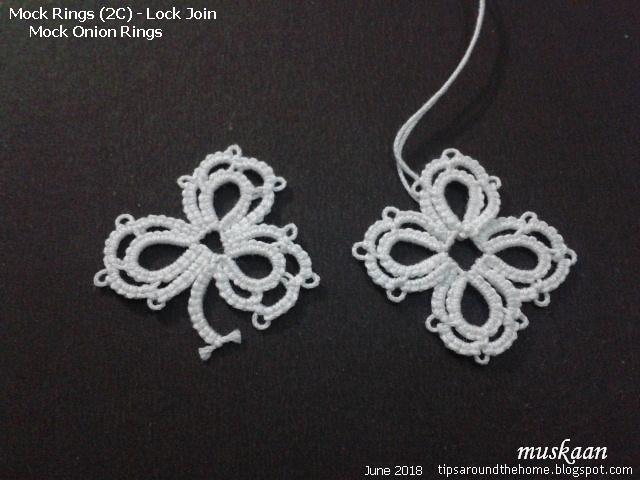
The Shamrock Leaf in above collage is made in 2 continuous rounds. The medallion of 3 free rings is made first, leaving a bit of bare thread space between each. These are true rings.
An outer chain round is then added. Each chain is lock joined to the bare thread between rings, giving the impression of onion rings.

[ Reference for section 2C is from the Craftree thread: Are these very old onion rings?. It refers to a pattern on p.28 of The Ladies’ Worktable (1871, March 4). ]


2D. Lock Join: to bare thread/base of previous element 


In onion rings, with each additional layer, the size of ring increases and a large ring is difficult to close. So, instead of true rings, the outer layers are worked as chains in both needle and shuttle tatting. Each chain layer is lock joined to the space at the beginning of that layer. It now resembles a ring.
In the above collage, the 2 inner cream rings are true rings followed by a chain using ball thread. After encircling the rings, the chain is lock joined to the tiny space between two layers. We can continue to add more layers in similar manner.
In the Dancing Peacocks medallions, only the innermost ring is true. Switching between 2 shuttles with different threads provided alternating colours.

In the lead pic, the mock onion ring on the left is made with twin true rings, followed by 2 mock ring layers or chains joined back around. 

[ For more details on onion rings and mock onion rings - Types of Rings by Judith Connors
(free sign in to Craftree to access document) ]

This concludes Category 2 - Mock rings made with lock join. Even though lock join is an essential feature of the next set of mock rings, the 3rd category will focus on linking to a picot at the start/base of the chain itself. 

....to be continued

Related Posts

Monday, 4 April 2016

Shuttle 2 to the Rescue !

Pin It now!
JOINS  IN  SHUTTLE  TATTING
IN SEARCH OF COMMON PRINCIPLES
PART – II

CATEGORY I. ABOVE  (contd.)

A Brief  Recap :
When a link needs to be made to a previous element Above the line of present working, the ball/SH2 thread is closer to the joining picot. Hence SH2 thread comes into play in the Picot joins (up, down, in a circle, swirl join)  the Lark’s Head Picot Join as discussed in Part I. The remaining joins in this same category are discussed below. 

Abbreviations used here :
SH – shuttle
SR – split ring
DS – double stitch
LHPJ – lark’s head picot join
RS – reverse stitch (unflipped stitches)
hs – half stitch
uSHS – unflipped 2nd half stitch
LJ – lock join

About Pics :
In the tatted samples worked in size 20 thread, yellow represents core/SH1 thread ; aqua blue represents ball/SH2/auxiliary thread ; black represents a previous tatted element with a picot to which current working needs to be linked.

A Note of Caution on Colour Blips/Spots:
I have used a 3rd colour (black) to represent a previous element. However, in actual tatting, when working with 2 colours, this previous element may be the colour of either SH1 or SH2 thread. When joining picot is the same colour as the stitch colour in present working, colour blips may not be visible.
For example, in LHPJ, if black, which has the joining picot, was substituted with aqua blue (SH2), no colour blip will show on back side. But if black is substituted with yellow (SH1), a colour blip will be visible on back side.

Rule : In two-colour tatting, if joining picot from previous element and current stitch are of same colour, colour blips/spots are usually not seen on the front side.

I.3 Joining the Second Half of a Split Ring  :
While linking the 2nd half of a split ring (SR), the picot may seem to be below the ring being made, but notice the caps on the two elements : they face each other. Hence it belongs to the ‘Above’ category of joins. 
Pic 6.  Explaining the visuals for Part II
A split ring has two halves : the first half (yellow in pics) is worked like a normal ring with flipped stitches or DS and any links on this side will include the Picot Joins and LHPJ (Refer I.1, I.2). The second half of a SR is made with reverse or unflipped stitches using SH2 and the SH1/core thread shuttle is not on hand. Thus the linkage calls for slight modification of movements, to ensure the core thread continues to slide freely after the join is made.
There are 3 main ways to accomplish this linkage :

I.3.a  Split Ring Join 
UPDATE: Reverse Stitch Join is a better, generic term since the same method/join is used in case of direct tatted chains, etc. The join is basically a feature of the reverse stitch, and not the element.
aka Transitional join10, Split Ring Core join11, Join to second side of SR12, Joining second half of SR13.
One comes across different names, as listed above, but the basic movement and formation remains the same. They have, therefore, been clubbed together under ‘Split Ring Join’ in order to distinguish this formation from 1.3.b & c.

  • A loop of SH1/core thread is pulled Up or Down through picot, and SH2 is passed through it. The core thread is then tensioned so that it ‘pops’ back from the picot with the SH2 thread wrapped around it.
  • It allows core thread to slide freely.
  • This join can be counted as a hs.
  • An up loop creates a colour blip on the front side; a down loop creates a colour blip on back side. Hence when working with 2 colours, use a Down loop to keep colour blips at back of work14.    
  • Any element (ring or chain) worked with RS can be linked with this join.
  • It follows the basic principle of a picot join.
Pic 7. Split Ring Join made with
Up & Down loops

(click on image to enlarge)

Rule : It is advisable to keep the loop that is pulled through joining picot untwisted while passing shuttle through loop for making any join.

I.3.b Lark’s Head Picot Join with Shuttle 2 (S2LHPJ) 15
This is a slightly elaborate multi-step procedure to wrap and flip a complete DS within the joining picot, thus creating an “invisible join”. While the 1st half of a SR can be joined using a LHPJ, the 2nd half needs to be wrapped a bit differently.   
  • 1uSHS is made outside the picot, before commencing the linkage formation within picot.
  • A loop from SH2 is pulled up through picot and SH2 passed through loop. Several ensuing movements enable the formation of a DS which is snugged into position. 
  • The join is counted as 1 complete stitch and lies within the picot.
  • Useful for smooth visual effect, with a continuous line of stitches.
  • A colour blip will be seen at the back only if joining picot is of different colour.
  • Any element (ring or chain) worked with RS can be linked with this join. 
Pic 8. Lark's Head Picot Join
made with Shuttle 2 (S2LHPJ)

I.3.c  Lock Join with Shuttle 2 thread
A third way to join SR is with a lock/shuttle join using SH2.
  • Pull a loop of SH2 through picot, pass SH2 through loop, adjust  tension carefully.
  • It locks the SH2 thread, while keeping SH1/core thread free.
  • This is a very easy and quick method. But care must be taken to position the thread carefully before final tensioning.
  • It does not create much of a colour blip.
  • It leaves a visible bump/bar along the line of stitches which may not be visually appealing.
[update] This join is also used in Inverted Tatting. Also called Ball Lock Join - http://www.georgiaseitz.com/2004/joins/mminvertedtat.jpg 
Pic 9. Lock Joins using Shuttle 2

The ball thread join 16
A decorative variation of LJ with SH2 which can be employed in all kinds of rings and chains.   
The movements of I.3.c are followed, but a space of thread is left on either side. (refer Pic 9)
The bare thread space of SH2 before and after the LJ imitate the picots in the element being worked. Thus the actual join is not placed in line with the previous stitches; it is placed at the tip of a mock picot. It enables the tatter to maintain, and continue with the decorative look of the element which is being linked.


This completes Category I. 
In Part III we will consider Category II where links are made Across elements.

Feedback, correction, or addition is welcome.
I will convert this entire series into a pdf file for easy reference, with requisite updates and modifications. 

Related Posts : Demystifying Joins  
_____________________________________________ 
Footnotes & Tutorials (Part II) :
14 Most tutorials show the Up loop being used to make the Split Ring join. Compare the up & down loop, as well as the SH2 movements in the collage picture.
15 Lily Morales 2003 
16 Martha Ess The instructions & pictures are shared in her Butterick Butterfly Bookmark pattern.


Friday, 4 September 2015

Unlocking the Lock Join

Pin It now!

A Tutorial 

Lock Join in shuttle tatting, is both a boon and a bane .
It is a secure join, made with the core thread shuttle. It stops the previous stitches from sliding over the core thread, thus holding them in check. It is a go-to join when one needs to join to a picot that is below the working segment ; it can be done with 1 shuttle and in one smooth motion .
But …
It is so secure that once made, it becomes difficult to undo. Hence one always sees this statutory warning in Lock Join tutorials : snug the stitches properly ; make sure all are in the right place ; Then tighten the join knot because it is difficult to undo. Yes, that’s exactly what it is : a Knot !
Yet …
We tatters know how often we have to retrace our steps, lock join or no lock join. So I pulled a few strings, literally, to make it easy to unlock ;-P
So …
Follows a pictorial with instructions on which strings to pull when & in which direction … I have broken it down into nano steps ; in practice, it can be quite a smooth movement – try it.

I am posting this because I could not find any tutorial, tip, or instruction on how to undo the LJ. If such exists, please share. I am only sharing what works for me.

In images, the blue-green is the shuttle/core thread, and yellow is ball/working thread, both in size 20. Using 2 colours in a pictorial/tutorial makes it easier to identify steps, sequence, etc.
Henceforth, Lock Join will be referred to as LJ ….
CWJ : Catherine Wheel Join

How to UnLock the Lock Join

 1. In order to make a LJ, one pulls a loop of the core thread Up through picot, then passes the shuttle through this loop, and tightens the knot securely in place.
Keep in mind (for later comparison) the position & directional movement of shuttle & loop , because we will have to come back through this path to undo the LJ.

2.  Two LJs made. As you can see, both are equally tensioned. But we are now going to undo the 2nd LJ.

3. Hold the stitches on the left (yellow) in your pinch & give a slight tug. Immediately, a part of core thread appears on the left side of the picot !

4. Gently, but persistently, keep pulling in same direction, away from the knot. The thread seems to unwrap itself gradually. The bare thread space starts to increase, and as seen in this extreme close-up, the knot has already loosened up a bit.
But, if you look carefully, the loop that emerges is on the ‘wrong’ side from where we made it initially ! It is pulled back behind the picot, rather than in front of it. Compare with 1st pic. 

5. Now simply give a quick sharp tug with the shuttle thread in opposite direction. This will pull the loop through the picot, bringing it in the front. And with a slight ‘pop’ for pleasurable satisfaction (remember the ‘pop’ in the CWJ!)
Voila! The loop has emerged through the picot ! You can see the loop in front of picot, with the shuttle thread neatly within. Compare with previous pic.

Pull this loop (shown in inset, with crochet hook within) open further either with your fingers or with a shuttle hook/tip.

 6. Now that the loop is large enough, pass the core thread shuttle through it (front to back) to reverse/retrace the very first step.

7. See, the shuttle is now free from the LJ loop. There is only a bare loop left. Pull shuttle further till even this loop is pulled away from the picot.

8. The Lock join has been unlocked !!!
Yes, it is That simple :-)


Quick Recap 
Pull chain segment towards left of LJ to open up a long bare thread space (of core thread).
Pull shuttle thread towards right of LJ till it 'pops' to the front.
Pull this loop out & pass shuttle through it to unravel the LJ.
That’s it – just 2 strings to pull ;-)

This works superbly for both size 20 & size 40 threads. As you know, I can’t count beyond that 😭 
But I’d love to know whether it works for the finer threads too. 


A few factoids :
Lock join aka Shuttle Join
LJs can be made either by pulling shuttle thread up through picot or by pulling shuttle thread down through the picot. (Note : If doing the latter, the final steps of unlocking the LJ will become the opposite of those shown in images)
Quick to make and in a contiguous motion.
When making a LJ, avoid pulling on the ball/working shuttle thread.  Once the LJ is made, continue with the next stitch. The reason becomes self-evident from the above pictorial!
It causes a slight dip in the chain and this arc can be used beautifully.


Limitations of LJ & Comparison with CWJ
In 2-colour tatting, LJ leaves a tiny blip of colour. This can be avoided by a CWJ where core thread is enclosed/encapsulated within the join.
LJ locks in the core thread. In CWJ, the core thread is free to slip along.
LJ gives a slight dip in a chain edge. CWJ keeps the outer edge of chain contiguous, since a full ds is made.
But CWJ needs 2 shuttles to work it, and it can also hamper the tatting rhythm,  since it has to be made with Shuttle 2.

Miranda has an Excellent comparative account of 3 joins (LJ, CWJ, Slope & Roll Join) along with actual tatting samplers. A must-read.

There is also a wealth of knowledge in terms of Joins, their characteristics, etc. in a discussion thread started by Judith Connors on Dora Young Knot here

I first learned the S&R & CWJ from the excellent diagrams here  (scroll to the bottom of page) 
There are many many more resources including videos.


happy tatting J