Showing posts with label tatted lobster. Show all posts

Tuesday, 7 May 2024

is it a plane

Pin It now!

or is it a lobster?! 

It's always fun when we can get a two-in-one pattern! And this time it was simply a matter of perspective. What for so many years appeared to be a lobster, turned out to be an equally impressionable light aircraft, merely by shifting the angle!
Add a few necessary embellishments to further strengthen the look you want - that of a plane or a lobster.

I tackled two tasks simultaneously. Updating the E38 pdf with a diagram and two-shuttle instructions, and tatting this 3D figure for our May2024 game called 'Inflate Me Endrucks' in our Endrucks 1920 Project FB group. 
All relevant links are at the end of the post.
Sharing the process here ---
1. I tatted one motif of the E38 Lobster edging. However, all along the edge, small picots were made after every 2 stitches in the element/segment. It is through these picots that the 2nd motif will be attached.  
2. A second identical motif was tatted and joined along the edges of the first one.

3. Leave sufficient space open at the end to insert stuffing. Notice how the inner space is all hollow.
4. Tails of the second motif are hidden.

5. Through the open space, stuff cling wrap, filling the hollow.
Then sew in the opening using a different coloured thread (the mustard ends are visible)

6. Stiffen the model. I used a 3:1 PVA glue to water ratio. I made enough solution to dunk the model in it, turning it over and over till I was certain every portion had absorbed the diluted glue. Then I left it to dry on the little rack above the bowl itself.
I was supposed to dab out the excess glue from the tatted stitches, but forgot.

7. When completely dry, snip off the stitches in the opening and remove all the stuffing. Then sew in the opening again using appropriate thread.

8. Seen from the other side.

9. I consider this the Lobster side and even though lobsters are caught in traps/pots, I exercised some creative licence to hook it!

10. This is the plane or light aircraft side. Inserted a jump ring and then a larger hoop on top to allow it to dangle. Although dangling it at the tip of a wing would work so much better!

The 3D version can be used a pendant, brooch, charm, or simply displayed as a collectors' model .....
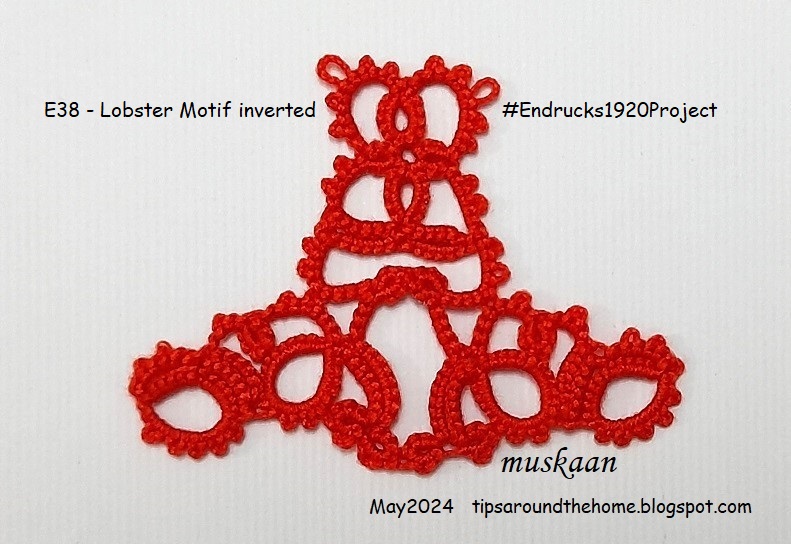
11. This is the motif upended. It appears like a citadel or those huge silos or oasts of old. There's always more to an Endrucks' design than meets the eye!!!
🦞✈️🦞✈️🦞✈️🦞

PROCESS: In converting the flat motifs to a 3D model, I referred to Pitsibaa's (Tinna Hassinen) video on how to puff up tatted motifs - https://www.youtube.com/watch?v=X0MInK7b65Q . The only real change I made was to join the 2nd motif to the 1st while it was being tatted. However, it was not as easy, and sewing two separate motifs would've been quicker.
TIP: I found it easier to join when the edge chains were direct-tatted (reverse stitch).
Further, this motif has a large open space which can be bridged with a thrown ring.

PATTERN: Endrucks' pattern #38 (E38) - Lobster Edging pattern pdf - https://drive.google.com/file/d/1EiWX78pK8oY8shFVGBFjdJIO0a4Y7fLh/view
This was prepared by Douglas Hill in Nov 2020 using a ball and shuttle. Ninetta and I are in the process of systematizing the presentations to include whatever is missing - diagram, written pattern, etc.  Hence this E38 pdf has now been updated with a diagram and short notation pattern using two shuttles. It is our endeavour to retain the  individualistic character of the volunteer's presentation despite the updates 

GAME: Our May 2024 game for which I made this model is called Inflate Me Endrucks. If you wish to join, all details can be found in this pdf - https://drive.google.com/file/d/1A0hdxz54JbLCGLiDbI_-g53Xh7eNqeKQ/view
Now you see why I chose this particular motif/pattern - two tasks in one. Updated the pdf and participated in the game, LOL.
Ninetta prepared a biscornu-shaped pin cushion covered on either side with two E30 square motifs. We wanted to provide as many visual options and ideas as possible. 
While scrolling through the main patterns and the directories of derivatives, it was easy to spot so many possibilities! We hope our participants will also see them.

EP LINKS: All relevant Endrucks 1920 Project links can be found in this active doc - https://docs.google.com/document/d/1w1TZBg-HIzseGEUoJ-rko7tNbtSgZY5A18Oy2Y9Hh0Y/view

✈️🦞✈️🦞✈️🦞✈️
I am also presenting this plane/lobster as my submission for 'Small Decorations' game by splocik
Check out the April entries in the round up - https://splocik2.blogspot.com/2024/05/male-dekoracje-2024-galeria-kwietniowa.html  Since I do not celebrate Christmas or Easter, etc., my entries cannot relate to those decorations. However I hope they are still valid.

Monday, 16 May 2022

enthusiasm interrupted

Pin It now!

Reworked patterns from Frau Eleonore Endrucks-Leichtenstern’s ‘Die Schiffchen-Spitzen’, 1920, for Endrucks 1920 Project

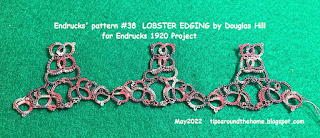
Did Frau Endrucks enjoy a plate of lobsters or perhaps watching them frolic in the water? Is it what inspired her edging #38? Are they holding claws for a dance or to avoid the traps?! Douglas Hill spotted lobsters, too, and named it the Lobster Edging

Lobster Edging (#38) pattern pdf:
https://drive.google.com/file/d/1EiWX78pK8oY8shFVGBFjdJIO0a4Y7fLh/view

I think it will be a good idea to include a diagram eventually.

This colourway does full justice to the arthropod. One could easily add a few beads and tweaks to strengthen the lobster motif. Great for applique and cards or perhaps a charm. Or how about a brooch, earrings, or pendant?

Incidentally, he preferred to tat it with a ball and shuttle rather than 2 shuttles, as seen in this WIP model. And to get the shuttle in position, a lot of shoe lace tricks (SLTs) were used.
Will this should make it easier for a needle tatter to follow the pattern?

He presented this pattern at the Finger Lakes Tatting Group mini-conference in September 2021, thus spreading the word about our Project.
When the lobsters are flipped, as in the above image, they give a very different look!

In 2020, Douglas had also chosen pattern #41 where he visualized the paired chains as a long row of short and long candles with the end rings acting as flames.

In order to get the long chains to stand straight, he wrote the pattern using balanced double stitch (BDS) in late 2021, but by the 3rd repeat in above sampler, he decided that the BDS did not work.

He was ‘frustrated… at not getting the pattern to work or look right…Ninetta and I tried to help with our joint review notes and possible options. However, he could ‘no longer boost his long exhausted enthusiasm’ and left this pattern as well as our Facebook group in Dec 2021.

The above is his working of pattern #7 which he chose in mid-2021. Again, not happy with his tatting, he forfeited the pattern.

Douglas is quite accomplished with the crochet hook, tatting shuttle, knitting needles and lace bobbins, including designing some spectacular crochet coats. Although he is not a regular blogger, do check out some of his works here - https://queerqrafter.com/ or on Facebook.
 
🦞🦞🦞🦞🦞🦞

AlenAlea Rako joined our Facebook group by adapting the pattern #3 edging into 2 square motifs that can be tessellated into a larger fabric if desired. She also graciously shared the pattern.

Two Squares (from #3) pattern pdf: 
https://drive.google.com/file/d/1eBwjp7wtMie1k2GeqrSUOerMH87uuu4A/view

In Square #1, she turned the corner inwards along the original sewing edge. This retains the beautiful lotus-shaped motif, with minimal changes to the original pattern.

Unhappy with the open space in the center of the square, she added an insert option for those who prefer denser lace. The insert is especially useful for larger lace fabric, providing additional sturdiness and durability.

It is always fun to ask ‘what if ….?’, and explore options! Hence this time, she turned the corner along the opposite edge resulting in an in-built denser flowery center. She shows us where we need to join motifs for tiling in her diagrams.

Unfortunately, Lea abandoned the pattern presentation maintaining absolute silence despite our private and public calls over the past several months. I have cleaned up the presentation (most of which she had approved earlier) and it is now available for all of us to enjoy.

Lea, too, is an accomplished tatting designer and hand dyes her threads creating beautiful colourways.

▦▩▦▩▦▩▦▩▦▩▦

Despite our best intentions life can get in the way of our commitments. Delays happen. Sometimes enthusiasm sags. Yet communication is key. As volunteering adults we should all be able to speak freely about any changes in commitment.

We thank both Douglas and AlenAlea for their contribution and hard work.

With best wishes and gratitude
muskaan and Ninetta 
💦💧💦💧💦💧💦💧💦

Related Posts
https://tipsaroundthehome.blogspot.com/2021/11/the-foster-child.html - pattern #7
https://tipsaroundthehome.blogspot.com/2021/11/willing-non-volunteer.html - pattern #7 adaptation
https://tipsaroundthehome.blogspot.com/2021/09/700-and-promises-still-to-keep.html - pattern #3
https://tipsaroundthehome.blogspot.com/2022/01/more-multiples.html - Square #3 using 2 colours
https://tipsaroundthehome.blogspot.com/2022/01/who-knew.html - Fruit Bowl from #3
https://tipsaroundthehome.blogspot.com/2022/03/bowled-over.html - Fruit Bowl pattern from #3

*********************
Endrucks 1920 Project is a community project, where patterns from Endrucks’ German book of 1920 were converted to modern-style presentations and pdfs. We welcome you to join our Facebook group “Endrucks 1920 Project” (please read the group’s description and rules before joining : https://www.facebook.com/groups/1235560633606162) where the fun continues with derivative tatting, new variations, activities, etc. all within the gamut of Endrucks’ patterns.

Using the hashtag #Endrucks1920Project when posting in FB or Instagram, ensures that your pic will show up in a search.

If you enjoy sharing and experimenting, or even test-tatting, the group is waiting for you! All info and links to patterns (original and modern), including model images, are in the Endrucks 1920 Project Document, here https://docs.google.com/document/d/17LEVftXweztBIOWh4sL4BB7bX65ssoOsOn4oXIgCepY/view There is still a lot to explore and extract, derive and apply and scrolling through this document will give you an idea of the possibilities and beyond.

*********************